

Introduction
If you spend any amount of time texting, gaming, or scrolling through Reddit threads, you’ve probably run into the letters “IIRC” tucked into a sentence. It shows up in casual chats, comment sections, work Slack channels, and even in the middle of heated online debates.
At first glance, it looks like just another random internet acronym. But IIRC actually carries a specific tone and purpose that changes how a sentence is read. Using it correctly can make you sound more thoughtful and less overconfident, while using it in the wrong place can make a message feel oddly out of place.
This guide breaks down exactly what IIRC means, where it came from, how people use it across different platforms, and the small mistakes that trip people up. By the end, you’ll know exactly when to use it, when to avoid it, and how to reply to it naturally.
Language on the internet moves fast, but a handful of acronyms have proven surprisingly durable. IIRC is one of them. It survived the shift from IRC channels and early message boards to modern texting apps, group chats, and social media comment sections, largely because it solves a problem that never really goes away: how do you share information you’re mostly sure about without sounding either too confident or too unsure?
Understanding IIRC properly means looking past the four letters and paying attention to tone, intent, and platform. That’s exactly what this guide covers, section by section, with real examples you can start using right away.
Meaning & Definition of IIRC
IIRC stands for “If I Recall Correctly” or “If I Remember Correctly.” Both versions mean the same thing, and people use them interchangeably depending on personal habit or regional preference.
Simple Definition:
IIRC is a short way of saying “based on my memory, this is accurate, but I’m not one hundred percent certain.” It’s a small verbal cushion that softens a statement before you make it.
Example:
“IIRC, the meeting got pushed to 3 PM.”
This sentence tells the reader that the writer believes the meeting time changed, but they’re leaving room for correction if they’re wrong.
Key Purpose:
The core purpose of IIRC is to add a layer of humility or caution to a statement. It signals three things at once:
- The person is sharing information from memory, not from a verified source
- They’re open to being corrected if the detail is wrong
- They want to keep the tone light and non-confrontational
It’s a small phrase, but it does a lot of conversational work in just four letters.
IIRC also acts as a social lubricant. Instead of stating something bluntly and risking being wrong in front of others, the speaker gets to share their best guess while quietly building in an escape route. If the detail turns out to be wrong, nobody feels embarrassed, because the disclaimer was already there from the start.
This is part of why IIRC feels so natural in fast-paced digital conversations. Text messages and comment threads don’t carry tone of voice or facial expressions, so a short qualifier like IIRC helps convey nuance that would otherwise be lost. Without it, a statement like “the meeting is at 3 PM” can sound like a confirmed fact. Add IIRC to the front, and it instantly reads as a friendly guess instead.
Read More: Brat Meaning Slang: What It Really Means in Text and Social Media Today
Background & Origin of IIRC
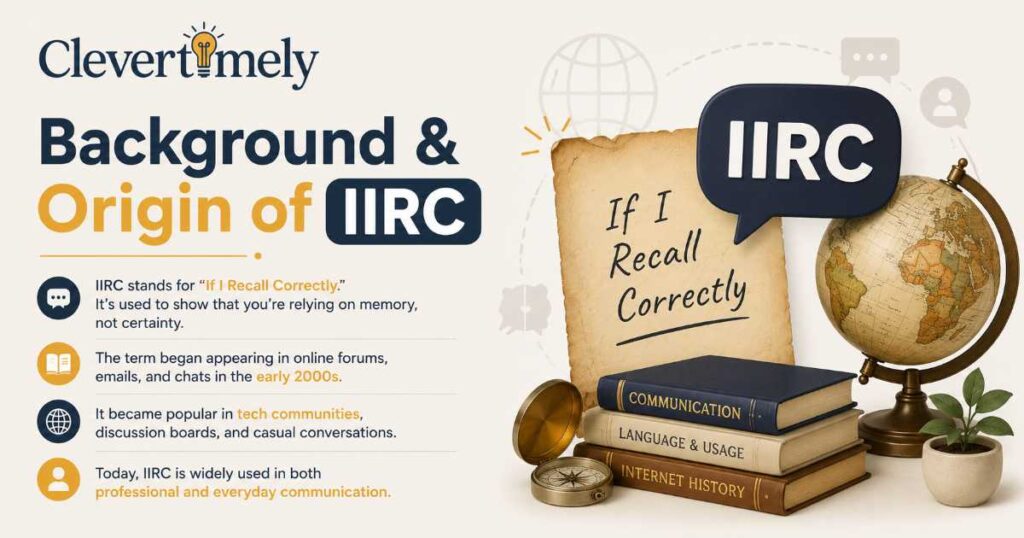
IIRC traces its roots back to the early internet chat culture of the 1990s, particularly on IRC (Internet Relay Chat) networks and early web forums. During this era, typing speed and character limits mattered, so users developed shorthand for common phrases to keep conversations flowing quickly.
The phrase “if I recall correctly” already existed in everyday spoken English long before the internet. People used it in person for centuries to soften a claim or admit a memory might be shaky. The internet simply compressed it into an initialism that fit the fast-paced, text-heavy nature of online chat.
As forums, instant messengers, and later social media platforms grew, IIRC spread from tech and gaming communities into mainstream online conversation. Unlike many internet acronyms that fade after a few years, IIRC has stayed remarkably consistent in meaning and popularity since its early days.
Part of the reason IIRC has aged so well comes down to how naturally it fits everyday speech. Many internet acronyms feel purely digital, invented specifically for typing convenience, but IIRC is essentially a shorthand version of a phrase people already said out loud long before texting existed. That familiarity made it easy to adopt and easy to understand, even for people who weren’t deeply involved in early internet culture.
Tech forums, gaming communities, and tabletop role-playing groups were early adopters of IIRC, since these spaces often involved recalling rules, lore, or past events from memory. From there, it spread naturally into broader online spaces as social media platforms grew and casual digital communication became the norm for everyone, not just tech-savvy users.
Usage in Different Contexts
IIRC adapts easily to different settings, but the tone it carries shifts slightly depending on where it’s used.
1. Casual Conversations
In everyday texting between friends or family, IIRC is used to soften a memory-based statement. It keeps things relaxed and avoids sounding overly confident.
Example: “IIRC, you still owe me ten bucks from last weekend.”
2. Online Discussions
On platforms like Reddit, X, and Discord, IIRC often appears when someone is answering a question or correcting a piece of information without sounding like a know-it-all.
Example: “IIRC, that update was released in early 2024, not last year.”
3. Professional Informal Emails
In workplace chats or casual internal emails, IIRC can be useful when referencing a detail you’re fairly confident about but haven’t double-checked, such as a meeting time or a past decision.
Example: “IIRC, we agreed to push the deadline to Friday, but let me confirm with the team.”
It’s worth noting that IIRC still leans informal, so it’s better suited for quick internal messages than formal client-facing communication.
4. Gaming & Forums
Gamers frequently use IIRC when discussing game mechanics, patch notes, or lore details they remember from memory rather than an official source.
Example: “IIRC, that boss fight got nerfed in the last patch.”
Gaming communities in particular rely on collective memory since patch notes, wikis, and official sources aren’t always checked before a discussion happens. IIRC lets players contribute useful information quickly without pretending to have memorized every patch note word for word.
Across all four contexts, the underlying purpose stays the same. IIRC signals that the speaker is contributing from memory rather than a verified source, while still keeping the conversation moving forward instead of pausing to fact-check every detail.
Meanings Across Platforms
While IIRC keeps the same core meaning everywhere, the way it’s used shifts slightly based on the platform’s culture and format.
| Platform | Common Usage Style |
| Used in personal chats to recall shared plans, dates, or promises casually. | |
| Appears in captions or comments when referencing a memory tied to a photo or moment. | |
| TikTok | Shows up in comment sections when users are recalling trends, sounds, or past videos. |
| Snapchat | Used briefly in chats or captions, often paired with emojis to keep the tone light. |
On WhatsApp, IIRC often pops up in group chats when someone is trying to settle a small disagreement about plans, dates, or who said what.
On Instagram, people often use IIRC in captions to add a nostalgic or reflective tone, such as referencing when a photo was taken.
TikTok
TikTok comment sections use IIRC frequently when discussing older trends, sounds, or creators, especially in “remember when” style threads.
Snapchat
Since Snapchat conversations are fast and disappearing, IIRC is used briefly, often shortened even further or combined with emojis for quick context.
Other Fields & Technical Meanings
Outside of internet slang, IIRC can also stand for different things depending on the industry or field, so context always matters.
- In some technical and organizational contexts, IIRC has been used as an abbreviation for specific institutes, councils, or research centers, though these usages are far less common than the internet slang meaning.
- In casual technical writing, developers sometimes use IIRC when referencing how a piece of code or a system behaved in the past, without being fully certain.
For the vast majority of everyday internet users, though, IIRC almost always refers to “if I recall correctly.”
If you come across IIRC in a technical document, an academic paper, or an organizational context and it doesn’t seem to fit the usual slang meaning, it’s worth checking the surrounding text closely, since acronyms often get reused across completely different industries. Context clues, such as the subject matter of the conversation or document, usually make the intended meaning clear within a sentence or two.
Common Misconceptions & Mistakes
Even though IIRC seems simple, a few common mix-ups happen regularly.
Mistake 1: Thinking it means certainty
Some people assume IIRC is used to state a fact confidently. In reality, it does the opposite. It signals uncertainty, not confirmation.
Mistake 2: Using it formally
Using IIRC in formal documents, official emails, or academic writing feels out of place. It belongs in casual or semi-casual digital conversations, not polished professional writing.
Mistake 3: Confusing it with IRC
IIRC is easily confused with IRC, which stands for Internet Relay Chat, an early online messaging protocol. The extra “I” in IIRC makes a big difference, since one is a slang phrase and the other is a chat technology.
Mixing these up in conversation rarely causes confusion once context is added, but it’s a common typo, especially for people typing quickly on mobile keyboards. If a sentence mentions chatrooms, servers, or protocols, it’s likely referring to IRC. If it’s about recalling a memory or fact, it’s IIRC.
Avoiding these three mistakes is usually enough to use IIRC confidently in almost any casual online setting.
Similar Terms & Alternatives
IIRC belongs to a small family of internet initialisms that express similar levels of uncertainty or humility in a message.
| Term | Meaning |
| AFAIK | As Far As I Know |
| IIUC | If I Understand Correctly |
| IMO | In My Opinion |
| FWIW | For What It’s Worth |
| AFAIR | As Far As I Recall |
These terms are often used in the same sentence style as IIRC, and swapping between them depends on whether you’re expressing memory, understanding, opinion, or general value of the statement.
For example, AFAIR is essentially a twin of IIRC, both pointing to memory-based uncertainty, while AFAIK leans more toward current knowledge rather than a specific past event. IMO shifts the focus entirely away from facts and toward personal preference, which is why it wouldn’t work as a direct substitute for IIRC in most sentences. Knowing these small distinctions helps you pick the most accurate acronym for what you actually mean, rather than defaulting to whichever one comes to mind first.
How to Respond to IIRC
Responding to IIRC is usually simple. You can either confirm, correct, or add more context.
Since IIRC already signals uncertainty, the person on the receiving end has room to respond casually without worrying about sounding harsh or dismissive. This back-and-forth is part of what makes IIRC useful in group chats and comment threads, since it invites a quick correction rather than shutting the conversation down.
Example 1:
Message: “IIRC, the store closes at 9 PM.” Reply: “Yep, that’s right.”
Example 2:
Message: “IIRC, we talked about this last week.” Reply: “Actually, I think that was two weeks ago.”
Example 3:
Message: “IIRC, this movie came out in 2019.” Reply: “Close, it was actually 2020.”
Example 4:
Message: “IIRC, you said you’d send the file today.” Reply: “Yes, sending it now, sorry for the delay.”
Differences From Similar Words
It helps to see IIRC next to its closest relatives to understand when each one fits best.
| Term | Focus | Best Used For |
| IIRC | Memory accuracy | Recalling a past event or detail |
| IMO | Personal opinion | Sharing a viewpoint |
| AFAIK | Current knowledge | Stating what you currently understand |
| IIUC | Understanding | Confirming comprehension of a topic |
The main difference is that IIRC is tied specifically to memory of the past, while the others relate more to current knowledge, opinion, or understanding.
A helpful way to remember the distinction is to ask what the sentence is actually about. If you’re recalling something that happened before, IIRC fits. If you’re describing what you currently know or believe, AFAIK or IMO usually fits better. Getting this right makes your messages read more naturally and avoids the slightly awkward feeling of using the wrong qualifier in the wrong context.
Relevance in Online Conversations & Dating Apps
IIRC shows up more often than people expect in casual and dating app conversations. On dating apps, it’s frequently used when referencing something mentioned earlier in a chat, such as a shared interest or a previous message.
Example: “IIRC, you said you love hiking, right?”
This usage works well because it shows attentiveness without sounding overly certain or presumptuous, which keeps early conversations feeling relaxed rather than intense.
In broader online conversations, IIRC also plays a role in keeping discussions civil. Adding it before a correction softens the delivery, making it less likely to come across as confrontational.
This matters more than it might seem, especially in text-based communication where tone can easily be misread. A blunt correction like “no, that’s wrong” can come across as harsh, even if that wasn’t the intent. Rephrasing it with IIRC, such as “IIRC, that’s actually not quite right,” keeps the same information while sounding noticeably friendlier. This small shift in wording is one reason IIRC continues to show up in disagreements across comment sections, group chats, and dating app conversations alike.
Popularity & Trends Over Time
IIRC has maintained steady popularity since its early days on internet forums and chat platforms. Unlike many slang terms that spike and disappear within a year or two, IIRC has stayed relevant across multiple generations of internet users.
A few reasons it has remained popular:
- It fills a genuine communication need that doesn’t have many simpler alternatives
- It works across almost every messaging platform without needing explanation
- It has been adopted by both younger and older internet users, unlike more niche Gen Z slang
While newer slang terms come and go quickly, IIRC continues to appear in everyday conversations, gaming communities, and online forums well into 2026.
Search trends and everyday usage both suggest IIRC isn’t going anywhere soon. Because it doesn’t carry any generational branding the way some newer slang does, it feels equally natural coming from a teenager, a young professional, or someone who’s been online since the early 2000s. That broad, generation-spanning appeal is rare for internet slang and is a big part of why IIRC has quietly become a permanent fixture of digital conversation rather than a passing trend.
FAQs
1. What does IIRC mean in text?
IIRC means “if I recall correctly” or “if I remember correctly.” It’s used before a statement to show the information comes from memory and might not be fully accurate.
2. Is IIRC formal or informal?
IIRC is informal. It fits casual texting, social media, and internal work chats, but it isn’t suited for formal writing or official documents.
3. Can I use IIRC in emails?
Yes, but only in casual or internal emails between colleagues who communicate informally. It’s best avoided in client-facing or formal business emails.
4. Is IIRC still used today?
Yes, IIRC remains widely used across texting apps, social media, forums, and gaming communities as of 2026.
5. What is the difference between IIRC and IMO?
IIRC refers to recalling a memory or past detail, while IMO expresses a personal opinion. They serve different purposes even though both soften a statement.
Conclusion
IIRC might just be four letters, but it carries real conversational value. It softens statements, adds honesty about memory limits, and keeps online conversations friendly rather than confrontational. Whether you’re texting a friend, replying in a forum thread, or chatting on a dating app, using IIRC correctly shows that you’re being thoughtful rather than overconfident.
Now that you know its meaning, origin, and the small mistakes to avoid, you can use IIRC naturally and understand it instantly whenever it pops up in your conversations.

