


Introduction
If you have ever been scrolling through a Snapchat message, a TikTok comment section, or a casual group chat and suddenly stumbled upon the letters “ASL,” you are not alone in wondering what it means. Three simple letters, yet they carry a surprisingly layered history in the world of digital communication.
In the age of texting, emojis, and fast online chats, abbreviations like ASL leave many people scratching their heads. Whether you are a parent trying to decode what your teenager is saying online, a new social media user trying to keep up, or simply someone curious about internet culture, understanding ASL is genuinely useful.
This article breaks down everything you need to know about ASL as a text slang term. You will discover where it came from, what it means today on different platforms, how it has evolved across generations, and why it still matters in 2026.
ASL in Text: Decoding the Abbreviation’s Meaning
Before anything else, let’s answer the core question directly.
ASL is an internet abbreviation that stands for “age, sex, and location,” usually asked as a question in romantic or sexual contexts online. It is also used as internet slang for the intensifying expression “as hell.”
So technically, ASL has more than one meaning. The version you encounter depends almost entirely on context. Here is a quick overview:
| Meaning | Context | Example |
| Age, Sex, Location | Early chatrooms, some DMs, dating apps | “ASL?” at the start of a conversation |
| As Hell | Gen Z slang, TikTok, Snapchat, texting | “That was funny asl” |
| American Sign Language | Educational, Deaf community, academic | “I’m learning ASL this semester” |
Capital letters often signal the older meaning (Age/Sex/Location), while lowercase “asl” is most commonly modern slang for “as hell.” That small detail alone can save a lot of confusion.
Read More: What Does SSA Mean in Text: Texting Guide (2026)
Unmasking ASL: What Does it Really Mean?
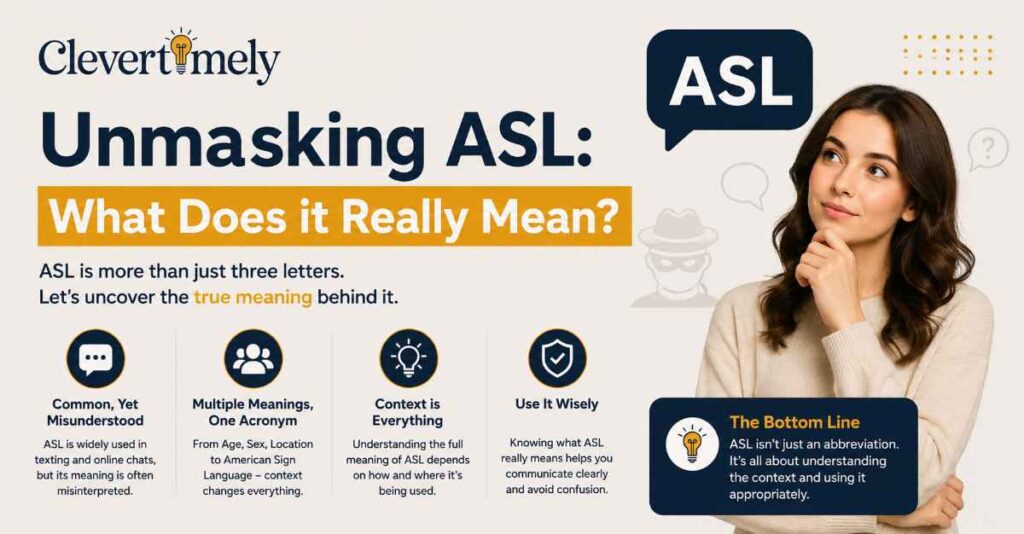
Let’s go deeper into each meaning so there is no ambiguity left.
ASL as Age, Sex, Location
The ASL meaning in text referring to Age, Sex, Location comes from early internet culture, where people wanted fast ways to learn who they were talking to. Instead of typing three separate questions, users condensed them into one short phrase.
It was a practical shorthand for its time. Someone new to a chatroom could type “ASL?” and immediately receive three pieces of basic identifying information from the other person.
ASL as “As Hell”
In modern texting and social media slang, ASL can mean “As Hell,” used to emphasize something strongly, similar to saying “very” or “extremely.” For example, someone might write “I’m tired asl” or “That movie was funny asl,” meaning they are very tired or the movie was extremely funny.
This is the version that Gen Z has claimed as their own, and it dominates most modern usage on platforms like TikTok, Snapchat, and Instagram.
ASL as American Sign Language
The original definition of ASL stands for American Sign Language, used by those who are deaf or hard of hearing to communicate through hands and facial expressions. This meaning is completely separate from internet slang and deserves its own respectful context. When you see ASL in an educational setting or a discussion about the Deaf community, this is the meaning being referenced.
ASL Through the Ages: Tracing the Evolution of Online Communication
The story of ASL as internet slang is really the story of how digital communication itself has changed over the past three decades.
The Chatroom Era (1990s to Early 2000s)
Originally standing for “Age/Sex/Location” in 1990s chatrooms, ASL was the standard opener for online introductions. Platforms like AOL Instant Messenger, IRC channels, and early chat forums were filled with strangers connecting for the first time. ASL served as the quickest possible icebreaker.
Its usage peaked during the late 1990s and early 2000s, especially among teenagers exploring online communities.
The Social Media Shift (2010s)
As social media platforms replaced anonymous chatrooms, the “Age, Sex, Location” version of ASL began fading. People’s profiles already showed their names, photos, and general locations, making the question redundant. Privacy concerns also grew stronger, making the idea of sharing your location with a stranger feel outdated and even risky.
The Gen Z Reclamation (2019 to Present)
Gen Z effectively claimed ASL for their own purposes, erasing its “creepy chatroom question” reputation through mass reappropriation. Twitter simultaneously adopted the “as hell” usage, with tweets like “traffic was crazy asl” spreading the slang beyond TikTok into mainstream internet culture.
By 2021 and 2022, the lowercase “asl” used as an intensifier had achieved widespread recognition among Gen Z and younger millennials. The abbreviation had completed a full transformation.
ASL in Online Interactions: Beyond the Surface
Understanding ASL goes beyond just knowing its definitions. How it functions in real conversations matters just as much.
When ASL is used as Age, Sex, Location, it appears as a direct question, often at the start of a chat. For example, “ASL?” clearly asks for personal details. When ASL means “as hell,” it appears after an adjective. Phrases like “bored asl” or “tired asl” show strong emotion, not a request for information.
Here is how ASL appears differently across various digital spaces:
- Friend group chats: Almost always means “as hell,” used to exaggerate a feeling
- DMs with strangers: Could still mean Age, Sex, Location, especially on older platforms or dating apps
- TikTok comment sections: Nearly always “as hell,” used for humor or emphasis
- Educational discussions: Almost certainly refers to American Sign Language
- Gaming lobbies: Mixed; depends on whether the community skews older or younger
ASL on Snapchat
On Snapchat, ASL generally means Age, Sex, Location when used in private conversations. Because Snapchat is a platform where users often connect with new people through streaks, mutual friends, or public stories, the original chatroom-style question still shows up occasionally. However, among established friend groups on Snapchat, the “as hell” meaning is far more common in quick back-and-forth messages.
ASL on TikTok
TikTok dominates ASL’s modern popularity. Creators use “asl” in video captions, text overlays, and voiceovers to emphasize dramatic moments. TikTok comment sections overflow with ASL usage, with phrases like “This is funny asl” or “I felt that asl” appearing constantly, creating community through shared slang understanding.
In some TikTok captions, ASL can also refer to American Sign Language content. Deaf creators and ASL educators use the hashtag ASL to reach audiences interested in learning sign language, so the context shift can happen even within the same platform.
Cultural Context: ASL’s Role in Digital Communication
It is worth stepping back to appreciate why abbreviations like ASL matter at a cultural level.
Digital communication runs on speed and brevity. A full sentence takes seconds to type on a phone keyboard. An acronym takes a fraction of that time. But abbreviations do more than save time: they signal group identity. Knowing what “asl” means in 2026 tells others that you are fluent in current internet culture.
Older members of the Deaf community see “ASL” as American Sign Language, not slang. Younger people who grew up with digital tools use slang like “asl” in entirely new ways. This difference can cause confusion, so context always matters.
This generational divide around a three-letter abbreviation actually mirrors a much larger reality: language adapts differently across age groups, communities, and platforms. A parent and a teenager might read the exact same message containing “asl” and walk away with completely different interpretations.
Among Gen Z, the “Age, Sex, Location” usage has mostly been replaced by the “as hell” usage. That shift happened organically, through millions of social media posts, not through any announcement or formal change.
The New Normal: ASL’s Integration into Modern Vernacular
ASL as an intensifier has well and truly entered everyday digital vocabulary. People use “asl” to emphasize how strongly they feel about something or to highlight the intensity of an action or reaction. You might also see it used to express feelings like “mad asl” for being very angry or “happy asl” for feeling extremely happy.
What makes this evolution particularly interesting is how it mirrors other slang terms that repurpose existing words. Just as “sick” came to mean impressive, and “dead” came to mean finding something hysterically funny, “asl” has been detached from its original question format and converted into a pure amplifier.
Some common examples of ASL used as “as hell” in everyday texting:
- “That exam was hard asl”
- “She’s talented asl”
- “I’m hungry asl right now”
- “That show was boring asl”
- “He was rude asl for no reason”
Each of these follows the same simple formula: adjective plus “asl” to dramatically strengthen the description. There is no question being asked. No personal information is being requested. It is purely about emotional intensity.
In 2026, slang is less about grammar and more about identity. People use it to sound casual, fit in with peers, and communicate emotion quickly without long explanations.
Interpreting ASL: From Text Slang to Real-Life Conversations
One challenge with text slang is that it does not always translate cleanly into spoken conversation. “As hell” is a phrase people say out loud, but nobody actually says “asl” when speaking. It lives purely in the written digital world.
In professional settings, only American Sign Language or the full term spelled out should be used. Using “asl” informally in professional contexts can seem unclear or confusing.
Knowing when not to use a slang term is just as valuable as knowing what it means. Here is a practical guide:
| Setting | Appropriate Use of ASL? |
| Texting friends | Yes, as “as hell” or casual question |
| Social media comments | Yes, as “as hell” for emphasis |
| Work emails | No |
| Academic writing | Only for American Sign Language, spelled out |
| Dating apps | Proceed with caution; context matters |
| Gaming chats | Yes, especially “as hell” version |
Parental Perspective: Understanding ASL in Teen Communication
For parents, decoding teen slang can feel like learning a foreign language. ASL is a perfect example of why keeping up matters.
As a parent, it is important to keep up with kids’ slang words to understand if they are in danger or not. Knowing what ASL means helps you protect your child from online predators. In teen communication and new-age slang, ASL usually refers to “as hell.” However, you could also find this acronym among common slang terms that mark “age, sex, location,” and it strongly depends on the context.
The key distinction for parents is understanding which version of ASL their child is encountering. Seeing “that test was hard asl” in their messages is completely harmless. Seeing “ASL?” come from an unknown contact is a different situation worth paying attention to.
With just a three-letter phrase, someone online can obtain sensitive information from your teen. It is best to talk to your child to make them understand that they should not answer this question from strangers. If someone asks them about their ASL, they should ignore the message and consider stopping the conversation altogether since the stranger might have bad intentions.
Key signs that can help parents interpret which ASL meaning is being used:
- If “asl” appears at the end of a sentence describing a feeling or situation, it is the “as hell” version
- If “ASL?” appears as a standalone message or conversation opener from an unknown contact, it is likely the personal information request
- Lowercase usage strongly leans toward “as hell”; uppercase with a question mark leans toward the older meaning
Fostering Communication with Family Orbit
One of the best ways parents can stay informed about their children’s digital lives is not through surveillance but through open conversation. When parents understand slang like ASL, they can ask informed questions without overreacting to harmless teen speech.
Using parental monitoring tools can also provide a safety layer without destroying trust. Apps and platforms designed for family digital safety allow parents to see context around their children’s conversations rather than jumping to conclusions about unfamiliar terms.
Some practical steps for families include:
- Having regular, judgment-free conversations about what platforms teens use and why
- Learning common slang terms together as a way to bond rather than police
- Establishing clear guidelines around sharing personal information like location with strangers online
- Teaching teens to recognize the difference between casual slang and potentially risky questions
- Encouraging teens to report any messages that make them uncomfortable, regardless of whether the language used is familiar
The goal is not to monitor every message but to build enough trust and communication that teens feel comfortable coming to you when something feels off.
Conclusion: Embracing ASL as a Language Bridge
ASL is a small abbreviation that tells a big story. It started as a practical shorthand in the early days of anonymous online chatrooms, asking strangers for their age, sex, and location. Over decades, it transformed into a Gen Z expression of intensity, completely detached from its original meaning. And separately, it has always represented American Sign Language, a full and rich communication system used by the Deaf community.
Understanding online abbreviations like ASL helps you navigate digital conversations with confidence. It is a quick, casual way to ask for basic information in one context and a way to intensify emotion in another. Context, tone, and platform always matter.
Whether you are a teenager using “tired asl” in a group chat, a parent trying to figure out what your kid just sent, or a curious adult catching up on internet culture, understanding ASL keeps you fluent in the language of digital life. And in a world where most communication happens through a screen, that fluency matters more than ever.
Frequently Asked Questions
What does ASL mean in a text message?
ASL most commonly means “Age, Sex, Location” as a question, or “as hell” as an intensifier in casual texting. Context tells you which meaning applies.
Is ASL still used in 2026?
Yes. The “as hell” version is very common among Gen Z on social media. The “Age, Sex, Location” version still appears but is considered older internet slang.
What does ASL mean on TikTok?
On TikTok, ASL almost always means “as hell,” used to exaggerate emotions or reactions in captions and comments.
What does ASL mean on Snapchat?
On Snapchat, ASL in a private message from someone unfamiliar typically means “Age, Sex, Location.” Among friends, it usually means “as hell.”
Is it safe to answer ASL from a stranger?
No, you should not share personal details like your age, gender, or location with people you do not know online. Privacy comes first.
Does ASL have anything to do with sign language?
Yes, ASL also stands for American Sign Language. This meaning is used in educational, cultural, and Deaf community contexts and is completely unrelated to the text slang versions.
Why do people write “asl” in lowercase?
Lowercase “asl” is the modern Gen Z way of writing the “as hell” version. Uppercase “ASL” is more often linked to either American Sign Language or the older “Age, Sex, Location” usage.
Can parents use ASL in conversation with teens?
Yes, knowing what ASL means helps parents have more informed, relevant conversations with their teens about online safety and communication.

