


Introduction
If you have scrolled through TikTok, Instagram, or a group chat lately, chances are you have run into the word “cap.” Maybe a friend called out your story as “cap,” or someone ended a bold claim with “no cap.” Either way, you were left wondering what it actually means.
“Cap” is one of the most widely used slang terms in online conversations today. It shows up in comments, captions, texts, and everyday speech among teens and young adults. Understanding it is not just useful for keeping up with internet culture, it also helps you avoid awkward misunderstandings in chats and on social media.
This guide breaks down everything you need to know about cap slang: its real meaning, where it came from, how it is used across different platforms, and how you can respond to it naturally. By the end, you will be able to use the term confidently and understand it every time it pops up in your feed.
Slang moves fast, and terms that felt fresh a couple of years ago can already sound dated by the time you catch on. Cap is a bit different. Instead of fading out, it has settled into daily digital vocabulary, appearing in casual texts, viral videos, and even brand marketing aimed at younger audiences. That staying power is exactly why so many people search for a clear, reliable explanation of what it actually means.
Meaning & Definition of Cap Slang
In simple terms, cap means a lie, an exaggeration, or something that is not true. When someone says “that’s cap,” they are calling a statement fake or dishonest. It is basically a shorter, more casual way of saying “that’s a lie” or “I don’t believe you.”
On the flip side, “no cap” means the opposite. It signals that someone is being completely honest and serious about what they just said. Think of it as an emphasis tool, similar to saying “I swear” or “for real.”
Here is a quick breakdown:
| Term | Meaning | Example |
| Cap | A lie or exaggeration | “You ran a mile in 4 minutes? That’s cap.” |
| No cap | Telling the truth, being serious | “This is the best burger I’ve had, no cap.” |
| Capping | The act of lying or bragging | “Stop capping, you weren’t even there.” |
| Cap emoji 🧢 | Visual shorthand for “lie” | Used in comments instead of typing “cap” |
Secondary meanings
While the “lie” meaning dominates online spaces, cap has a few other uses depending on context:
- Upper limit or ceiling: In finance, gaming, and everyday speech, “cap” can refer to a maximum limit, such as a salary cap or a spending cap.
- Headwear: The literal meaning of a cap, as in a baseball cap, still exists and is used in fashion or product contexts.
- Formal ceremony term: In academic settings, a “cap” refers to the graduation cap worn during commencement.
The slang meaning is what dominates search interest and social media use today, so the rest of this guide focuses on that definition.
Read More: SYBAU Meaning Full Form, Origins, Social Media Use & Online Trends Explained In 2026
Background & Origin of Cap Slang
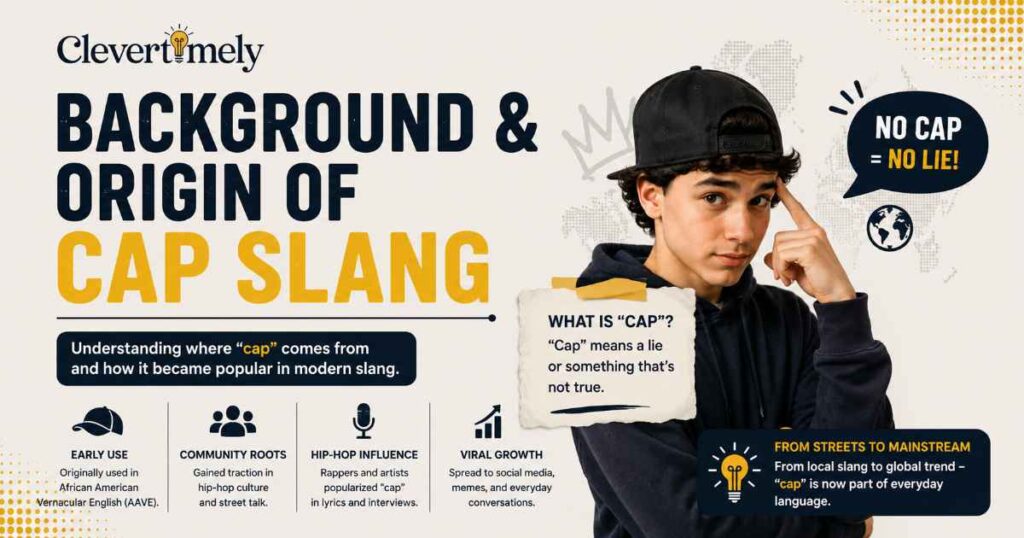
The slang use of cap did not appear overnight. Its roots trace back much further than most people realize.
According to language researchers, the verbal tradition of “capping” goes back centuries, describing a kind of verbal contest where people would top each other’s stories, jokes, or insults. By the 1940s, the term had become closely associated with African American communities, particularly through a wordplay game known as “the dozens,” where participants traded exaggerated insults for fun and to show off wit.
Over time, “to cap” shifted from meaning “to brag or exaggerate” to simply meaning “to lie.” This usage became firmly rooted in African American Vernacular English (AAVE) and stayed largely within Black communities and hip-hop culture for decades before spreading more widely.
The breakout moment for mainstream audiences came through music. Rap artists, including Migos, Future, and Young Thug, used “cap” and “no cap” in lyrics throughout the 2010s, introducing the phrase to millions of listeners outside its original community. From there, social media took over. Around 2018 to 2022, “cap” and “no cap” went viral on platforms like TikTok, Snapchat, and Instagram, cementing their place in everyday youth vocabulary.
There is also a popular myth floating around that “no cap” originated from comparing solid gold teeth to gold-capped teeth, the idea being that a solid tooth cannot be removed the way a cap can. Most linguists consider this an interesting story but not the true origin, more of a folk explanation that grew after the phrase was already popular.
By 2026, cap is no longer just a passing trend. It has become a fixture of digital communication, used across age groups and platforms whenever someone wants to question honesty or emphasize sincerity.
What makes this history worth knowing is that it shows cap is not a random internet invention. It is the latest chapter of a much older verbal tradition built around wit, storytelling, and calling out exaggeration, one that has simply found a new home on smartphones and social feeds instead of front porches and street corners.
Usage in Different Contexts
Cap does not always show up the same way. Its tone and intent shift depending on where and how it is used.
1. Chat conversations
In texting or DMs, cap is often used casually to question a claim someone just made. It usually appears as a short, punchy reaction rather than a full sentence.
Example: “You said you finished the assignment already? Cap.”
2. Social media posts
On platforms like Instagram and TikTok, cap frequently appears in captions or comment sections. People use it to react to bold claims in videos, viral posts, or influencer content.
Example: A comment under a video claiming a diet trick works instantly might simply read, “This is cap.”
3. Arguments or debates
During disagreements, whether online or in person, cap is used to challenge someone’s credibility. It works as a quick way to say you do not believe them without getting into a long explanation.
Example: “You said you never watch that show? Cap, I saw your watch history.”
4. Friendly teasing
Not every use of cap is confrontational. Friends often use it playfully to tease each other about small exaggerations, like bragging about a game score or a minor achievement.
Example: “Bro said he benched 300 pounds, major cap.”
Meanings Across Platforms
While the core definition of cap stays consistent, how it is expressed can differ slightly depending on the platform.
On WhatsApp, cap is mostly used in text form within personal or group chats. Since WhatsApp is more private and conversational, cap tends to appear in a lighthearted, back-and-forth way between friends or family members who are already familiar with slang.
Instagram sees heavy use of cap in comment sections, especially under posts making surprising or unbelievable claims. The 🧢 emoji is commonly used here as a quick, wordless way to call something out as fake.
TikTok
TikTok is arguably where cap usage is most visible. Creators use it in captions, and commenters use it constantly to challenge claims made in videos, whether about lifestyle, relationships, or “life hacks” that seem too good to be true.
Snapchat
On Snapchat, cap often shows up in captions on Snaps or in chat replies to a friend’s story. Because Snapchat conversations tend to be quick and informal, cap is used almost like a reflex response to anything that sounds exaggerated.
Other Fields & Technical Meanings
Outside of slang, “cap” carries specific meanings in other industries and contexts:
- Finance: Market cap refers to the total value of a company’s outstanding shares. A “cap” can also refer to a limit on interest rates or spending.
- Sports: Salary cap describes the maximum amount a team can spend on player salaries in leagues like the NFL or NBA.
- Gaming: Level cap or damage cap refers to the highest possible level or output a player or item can reach.
- Manufacturing: A cap can refer to a protective covering, such as a bottle cap or pen cap.
These meanings exist independently of the slang usage, but it is worth knowing them since search engines and readers sometimes look up “cap meaning” without slang in mind.
Common Misconceptions & Mistakes
Even people who use cap regularly sometimes get details mixed up. Here are a few common misconceptions:
- Thinking cap always means something negative: While cap points to dishonesty, it is often used playfully rather than as a serious accusation.
- Confusing cap with sarcasm: Cap is a direct statement calling something false, not a sarcastic remark.
- Assuming it is brand new slang: As covered earlier, the term has decades of history behind it, it just became mainstream more recently.
- Overusing it in formal settings: Using cap in professional emails, resumes, or academic writing comes across as out of place and unprofessional.
- Misreading “no cap” as related to headwear: Context almost always makes it clear, but it can confuse people unfamiliar with the slang.
Similar Terms & Alternatives
Cap is part of a larger family of slang terms related to honesty and exaggeration. Some common alternatives include:
- Fr fr: Short for “for real for real,” used similarly to no cap to emphasize truthfulness.
- On God: Another phrase used to stress sincerity, often interchangeable with no cap.
- Straight up: An older phrase meaning honestly or truthfully.
- Sus: Short for suspicious, used when something feels off or questionable rather than outright false.
- Facts: Used to agree with a true statement, the opposite reaction to calling something cap.
| Term | Meaning | Similar To |
| No cap | I’m being honest | For real, straight up |
| Fr fr | For real, for real | No cap |
| On God | I swear it’s true | No cap |
| Sus | Suspicious or questionable | Sketchy |
| Facts | Agreeing with truth | Correct, true |
How to Respond to “Cap” in Chat
If someone accuses you of capping, or you want to call out someone else, there are a few natural ways to respond.
- If you are being truthful, you can double down with “no cap, I swear.”
- You can provide proof or evidence to back up your claim.
- You can laugh it off if it was a playful accusation rather than a serious one.
- If you genuinely exaggerated, admitting it with humor keeps the conversation light.
Examples:
- Friend: “You said you met that celebrity? Cap.” You: “No cap, I have the photo to prove it.”
- Friend: “Bro said he ran a marathon in under 2 hours, that’s cap.” You: “Okay maybe I was capping a little, it was actually 4 hours.”
- Friend: “You’re capping, there’s no way you finished that whole show in one night.” You: “Fr fr, I didn’t sleep.”
Differences From Similar Words
People often mix up cap with other slang terms that sound related but mean different things.
| Word | Meaning | Different From Cap Because |
| Sus | Something seems suspicious | Cap is a direct claim of lying, sus is just doubt |
| Shade | Subtle insult or disrespect | Cap is about truth, shade is about tone |
| Flex | Showing off something impressive | Flexing can be true or false, cap always means false |
| Ghost | Ignoring someone suddenly | Unrelated to honesty, about communication |
| Lowkey | Doing something quietly or secretly | Describes intensity, not truthfulness |
Understanding these distinctions helps avoid confusion, especially since many of these terms show up together in the same conversations.
Relevance in Online Conversations & Dating Apps
Cap has become especially relevant in dating app culture, where exaggeration and dishonesty are common concerns. Many users use “no cap” in their bios to signal that they are being genuine about their interests, intentions, or personality traits.
On the flip side, calling someone’s profile or message “cap” is a common way to express skepticism about whether someone is being truthful, whether that is about their job, height, or interests. In digital dating spaces where trust is hard to establish quickly, cap has become a useful shorthand for questioning authenticity.
Beyond dating, cap plays a role in building credibility on social platforms generally. Influencers and content creators are frequently called out with “cap” in comment sections when their claims seem exaggerated, which shows how the term has become tied to online trust and accountability.
Popularity & Trends Over Time
Cap’s journey from a regional slang term to a global internet staple happened gradually before accelerating rapidly.
- 1900s to 1940s: Early use of “capping” as bragging or exaggerating within Black communities.
- 1940s onward: Strong association with the wordplay game known as the dozens.
- 2010s: Popularized through hip-hop lyrics from artists including Migos and Future.
- 2018 to 2022: Explosive growth on TikTok, Snapchat, and Instagram among Gen Z users.
- 2023 to 2026: Fully mainstream, used across age groups, brands, and even casual professional messaging in informal settings.
Search interest for terms like “what does cap mean” and “no cap meaning” continues to stay steady year after year, showing that the slang has settled into everyday digital vocabulary rather than fading out like many short-lived internet trends.
FAQs
1. What does cap mean in slang?
Cap means a lie, exaggeration, or something untrue. If someone says “that’s cap,” they are calling a statement false.
2. What does no cap mean?
No cap means someone is being completely honest and serious, similar to saying “I swear” or “for real.”
3. Is cap a bad word?
No, cap is not offensive or inappropriate. It is casual slang and generally acceptable in informal conversations.
4. Where did cap slang come from?
It originated in African American Vernacular English, tracing back to the tradition of “capping” or exaggerated storytelling and wordplay dating back decades.
5. Can I use cap in formal writing?
No, cap is informal slang and should be avoided in professional emails, academic papers, or formal documents.
6. What does stop capping mean?
Stop capping means asking someone to stop lying or exaggerating about something they said.
Conclusion
Cap has grown from a decades-old expression rooted in Black vernacular tradition into one of the most recognizable slang terms across social media and everyday conversation. At its core, it simply means a lie or exaggeration, while no cap signals honesty and sincerity.
Whether you come across it in a TikTok comment, a group chat, or a dating app bio, you now know exactly what it means and how to respond naturally. Slang like this continues to evolve, but understanding its roots and current usage helps you stay fluent in how people actually communicate online today.
Keeping up with terms like cap is not just about sounding current. It helps you read tone correctly, avoid misunderstandings, and connect more naturally in spaces where this kind of language is second nature. The next time someone tells you a story that sounds a little too impressive, you will know exactly what to say, and exactly what it means when they respond.

