

If you’ve ever spotted “CFS” in a text message, Instagram story, or TikTok comment and had absolutely no clue what it meant, you’re in good company. Slang moves fast online, and three-letter abbreviations like CFS can carry surprisingly deep social meaning depending on the platform and context. In 2026, CFS has firmly settled into everyday digital conversation, especially among Gen Z and younger millennials.
In this guide, you’ll learn the full CFS meaning slang, where it came from, how people use it across different platforms, and how to respond when someone drops it in a chat. No fluff, just clear and useful answers.
What Does CFS Mean in Text & Chat?
In most text messages and chat conversations today, CFS stands for “Close Friends Story.” It refers to the private story feature on Instagram where a user shares content with a hand-picked list of people instead of their entire followers list.
When someone says “I posted that on my CFS,” they mean the content was shared only with their inner circle, not publicly.
That said, CFS is also used in other ways depending on tone and context:
- Close Friends Story (most common, social media)
- Can’t Feel Sh*t / Can’t Feel Stuff (emotional expression, texting)
- Can’t Find Source (meme and content reposting communities)
- Call For Snap (Snapchat-specific, used to request a message or streak)
Context is everything. The same three letters can shift meaning completely based on platform, tone, and the people involved.
Read More Articles: 67 Meaning Slang
Full Form, Stands For & Short Meaning of CFS
Here’s a quick reference table for CFS across its most common uses:
| Context | Full Form | Meaning |
| Instagram / Social Media | Close Friends Story | Private story for a selected audience |
| Texting / Chat | Can’t Feel Sh*t | Emotional numbness or exhaustion |
| Meme Communities | Can’t Find Source | Original creator is unknown |
| Snapchat | Call For Snap | Request to send a Snapchat message |
| Medical | Chronic Fatigue Syndrome | A clinical health condition |
| Business / Finance | Cash Flow Statement | Financial reporting document |
Short meaning: CFS in slang almost always refers to Close Friends Story in social media contexts. In texting, it leans toward emotional expression. The surrounding conversation always gives it away.
CFS Meaning Slang Instagram
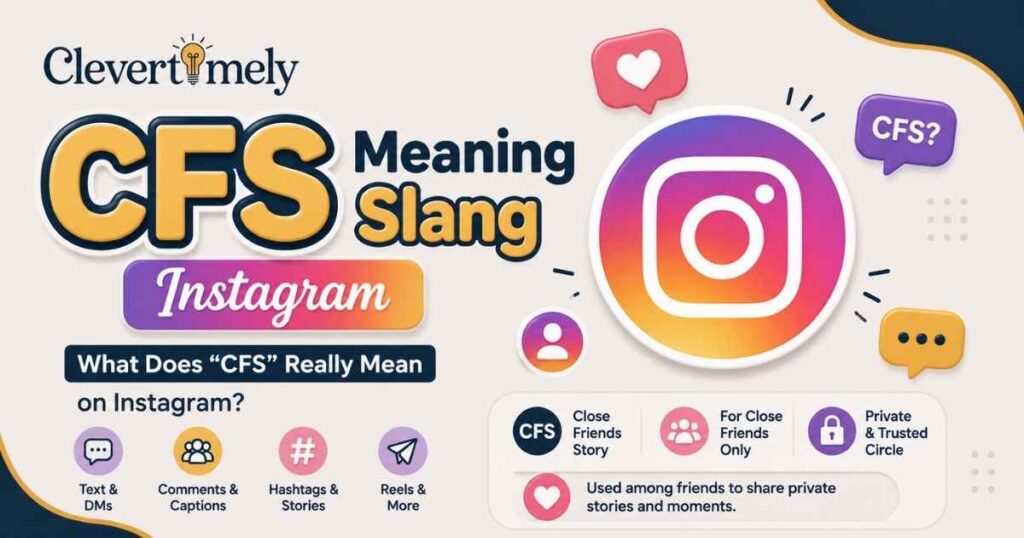
On Instagram specifically, CFS is tied directly to the Close Friends feature, which the platform introduced in 2018. This feature lets users build a private list of selected followers and share stories exclusively with that group.
You can spot a CFS in your Stories tray by a green ring around the profile picture instead of the usual pink-orange gradient. When you tap on it, a green “Close Friends” label appears at the top of the story.
Why CFS Matters on Instagram
- It signals trust and exclusivity
- Being added to someone’s CFS feels like getting a backstage pass to their real life
- Content shared on CFS tends to be more raw, personal, and unfiltered
- Being removed from someone’s CFS can feel surprisingly personal, even if it’s just a privacy preference
The phrase “Main is fake, CFS is real” became a popular caption style, showing how deeply the idea of public vs. private self has become part of digital culture.
How CFS Is Used in Instagram Captions and DMs
- “Post it on CFS, not main.”
- “Did you see her story? No? It was CFS only.”
- “You’re on my CFS now, you’re welcome.”
Origin, History & First Known Use of CFS
The abbreviation CFS existed long before Instagram made it popular. In early internet communities and forums, CFS was shorthand for “Can’t Find Source”, used by people reposting memes when the original creator was unknown.
Medical communities had been using CFS to refer to Chronic Fatigue Syndrome for decades, and finance professionals used it for Cash Flow Statement.
The slang shift happened in 2018, when Instagram launched its Close Friends feature. Users started abbreviating it naturally in DMs and comments. Over time, “CFS” made its way into group chats, TikTok captions, and even face-to-face conversations.
By 2024 and 2025, CFS had evolved beyond just a feature reference. It became a cultural shorthand for privacy, authenticity, and social trust. In 2026, it carries both a literal meaning (the Instagram feature) and a metaphorical one, as in “that’s CFS energy” or “you unlocked CFS access.”
How People Use CFS in Daily Conversations
CFS has worked its way into everyday language in several natural ways. Here are the most common patterns:
Describing Content Exclusivity
When someone wants to share something personal without broadcasting it to the world, they say they’ll “put it on CFS.” It’s a way of saying: this is for my trusted circle, not everyone.
Social Ranking and Inner Circles
Being on someone’s CFS has become a social signal. It implies closeness, mutual trust, and being part of the “real” version of someone’s life, not just their public persona.
Playful or Emotional Venting
In direct text conversations, CFS can shift to mean “Can’t Feel Sh*t” when someone is expressing emotional exhaustion. Usually paired with emojis like 💀 or 😭 to make the tone clear.
Common Phrases You’ll See
- “That’s CFS energy.”
- “Not CFS worthy.”
- “I’ll post it on CFS tonight.”
- “Why am I not on your CFS anymore 😭”
CFS Meaning Slang From a Girl
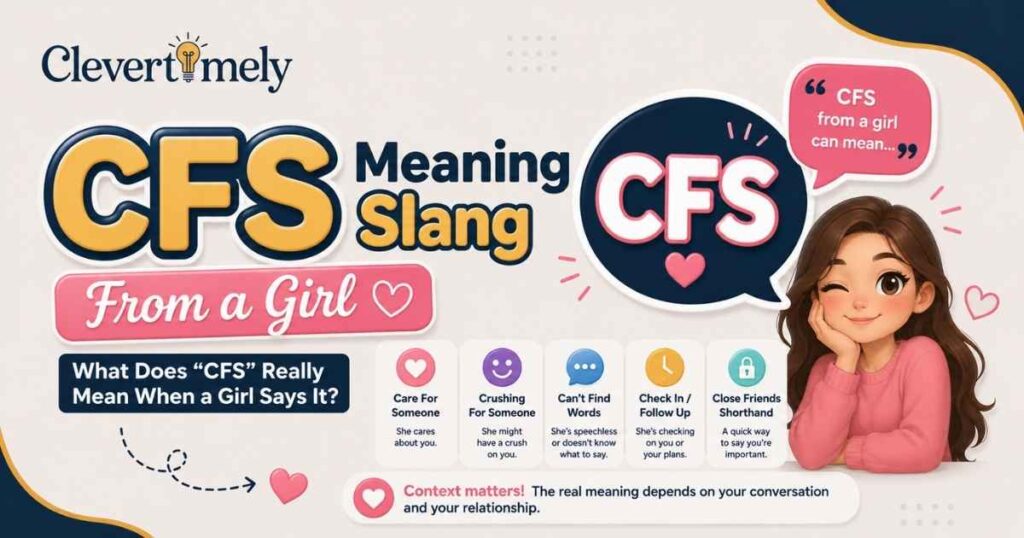
When a girl uses CFS in a text or comment, the meaning is typically the same as general usage, but the social weight tends to run a bit deeper.
Being added to a girl’s Close Friends Story is often read as a sign of genuine closeness. It means she trusts you enough to see her unfiltered content, her real thoughts, behind-the-scenes moments, and personal updates that aren’t meant for a wide audience.
If a girl says:
- “You’re on my CFS” – You’re in her inner circle, she trusts you.
- “That was CFS only” – She’s clarifying that content was private and intentionally limited.
- “I’ll CFS that” – She’s going to post something but keep it exclusive.
In emotional texting contexts, a girl might also use CFS to mean “Can’t Feel Stuff” when she’s feeling drained, numb, or overwhelmed. The emoji next to it usually clues you in on the tone.
CFS Meaning Across WhatsApp, Instagram, TikTok & Snapchat
CFS doesn’t behave the same way on every platform. Here’s how its meaning shifts depending on where you see it:
| Platform | Most Common CFS Meaning | How It’s Used |
| Close Friends Story | In DMs, captions, and bio references | |
| Close Friends Story or Can’t Feel Stuff | In group chats, story references | |
| TikTok | Close Friends Story / Private posting | In comments, captions, and creator references |
| Snapchat | Call For Snap / Private story | Asking someone to snap them or add to private story |
| Discord | Can’t Find Source / General slang | In server chats and meme-sharing channels |
Key Takeaway
Instagram owns the core meaning in 2026. On every other platform, CFS either borrows that meaning loosely or takes on a slightly adjusted version depending on the conversation.
Different Meanings of CFS in Other Fields
Outside of slang and social media, CFS has several professional and technical meanings worth knowing:
- Chronic Fatigue Syndrome (Medical): A serious long-term health condition affecting energy and daily function. Never assume this meaning in casual texting unless the topic is health-related.
- Cash Flow Statement (Finance/Accounting): A core financial document used in business reporting.
- Cubic Feet per Second (Engineering/Hydrology): A unit used to measure water flow rates.
- Call For Submissions (Creative Communities): An open invitation for artists, writers, or creators to submit work.
- Containerized Freight Station (Logistics): A facility used in cargo and shipping operations.
Understanding the field-specific meaning of CFS keeps you from mixing up a finance report with a private Instagram story.
Common Confusions, Mistakes & Wrong Interpretations
Even fluent slang users make mistakes with CFS. Here are the most frequent ones:
Thinking CFS Always Means Chronic Fatigue Syndrome
This is the most common mistake made by people outside Gen Z. In social media contexts, the medical meaning almost never applies unless someone is specifically talking about health.
Confusing CFS With CSF
CSF stands for cerebrospinal fluid, a medical term. The letters are one swap apart and easy to mix up in health-related conversations.
Assuming It Only Has One Meaning
CFS is highly context-dependent. Using it in a finance email when someone thinks you mean Close Friends Story, or vice versa, leads to real confusion.
Overusing It in Every Conversation
Forcing CFS into conversations where it doesn’t fit naturally sounds awkward. Use it when the context genuinely calls for it.
Using It in Professional Settings
Unless you work in social media marketing, dropping CFS in workplace messages can come across as out of place or confusing.
Similar Terms, Alternatives & Related Slang
If you’re building your digital vocabulary, these terms are closely related to CFS or often used alongside it:
| Term | Meaning |
| CF | Close Friends (short version, same idea) |
| Main | Public-facing content or account |
| Finsta | Fake Instagram, a secondary private account |
| Private Story | Similar to CFS but used more on Snapchat |
| Inner Circle | The trusted group of people who get access |
| NFS | Not For Show / No Funny Stuff |
| GNS | Good Night Streak (Snapchat) |
| DMs | Direct Messages, often where CFS gets discussed |
Related slang phrases:
- “CFS energy” – something that feels too personal to post publicly
- “CFS access” – being trusted enough to see private content
- “CFS moment” – a raw or unfiltered experience
Examples of CFS in Real Chat Situations
Here are natural, realistic examples of how CFS appears in actual conversations:
Example 1 – Instagram Context
Friend A: “Did you see Layla’s story last night?” Friend B: “No, I didn’t get anything.” Friend A: “Oh it was CFS only. You’re probably not on her list.”
Example 2 – Requesting Access
User: “You always post the funniest stuff. Wish I was on your CFS.” Reply: “Say less, I’ll add you right now.”
Example 3 – Emotional Texting (Can’t Feel Stuff)
“Haven’t slept in two days, CFS 💀 Don’t talk to me.”
Example 4 – TikTok Comments
Video caption: “Main is for the world. CFS is for the real ones.”
Example 5 – WhatsApp Group Chat
“Not posting this on my story but I’ll put it on CFS tonight, stay tuned.”
How to Reply When Someone Says CFS
Your reply depends entirely on context. Here’s a quick guide:
If someone says “I posted it on CFS”: Reply with: “Oh, am I on your list?” or “Can you add me?”
If someone says “That was CFS only”: Acknowledge the exclusivity: “Ohhh okay I get it, makes sense” or “Lucky if you made the list.”
If someone asks “CFS?” in response to your post: They’re asking to be added to your Close Friends. A simple “Added!” or “Sure, check now” works perfectly.
If the tone suggests emotional meaning (Can’t Feel Stuff): Read the emoji. If it’s 😭 or 💀, respond with empathy: “You okay?” or “I feel that honestly.”
The key is to match their energy and tone. Keep it casual unless the conversation clearly calls for something more serious.
Is CFS Still Popular? Trends & Online Usage
Yes, CFS is still going strong in 2026. According to usage trends across platforms:
- Instagram’s Close Friends feature continues to grow in active use, especially among users who want more control over their audience
- Gen Z and Gen Alpha actively use CFS as both a feature reference and a cultural expression
- TikTok pushed the phrase into mainstream awareness by making “main vs. CFS” a relatable content format
- The phrase “CFS energy” has picked up traction as a way of describing anything too personal or raw for public posting
Why CFS is staying relevant:
- Social media users are increasingly moving away from broadcasting everything publicly
- Micro-communities, private circles, and selective sharing are trending
- The emotional meaning of CFS (inner circle, trust, authenticity) resonates deeply with younger users
As long as private sharing features exist and digital privacy remains a concern, CFS will remain a part of everyday online vocabulary.
FAQs About CFS Meaning Slang
What is the most common meaning of CFS in 2026?
The most common meaning of CFS in 2026 is “Close Friends Story,” referring to Instagram’s private story-sharing feature for a selected group of followers.
Does CFS mean the same thing on all platforms?
No. On Instagram it means Close Friends Story, on Snapchat it often means Call For Snap or private story, and in texting it can mean Can’t Feel Stuff depending on context.
What does it mean if a girl says CFS to you?
It typically means she’s referencing a Close Friends Story, either inviting you in or mentioning she posted there. If emotional in tone, it might mean Can’t Feel Stuff.
Is CFS related to Chronic Fatigue Syndrome?
Only in medical contexts. In everyday texting and social media, CFS almost never refers to the medical condition unless health is the direct topic.
How do I know if I’m on someone’s CFS on Instagram?
If you can see a story with a green ring around their profile picture and a green “Close Friends” label at the top, you’re on their list.
Can CFS be used outside of Instagram?
Yes. The slang has spread to WhatsApp, TikTok, Snapchat, and Discord, though the exact meaning shifts slightly on each platform.
Is CFS appropriate to use in professional settings?
Generally no. Unless you’re in a social media marketing context, using CFS in professional emails or work messages can come across as confusing or out of place.
Conclusion
CFS is one of those slang terms that looks simple on the surface but carries real social and emotional weight in digital culture. In 2026, its primary meaning is Clear, consistent, and widely understood: Close Friends Story, the private sharing feature that has become a way for people to draw a line between their public persona and their authentic self.
Whether you’re trying to decode a message, understand why someone’s story has a green ring, or figure out how to respond when someone drops “CFS” in a chat, you now have all the context you need. The key takeaway is always the same: read the room, check the platform, and let the tone guide you.
Digital language evolves fast, but CFS has proven that it’s more than just a passing trend. It reflects how people think about trust, privacy, and connection in the social media age, and that conversation isn’t going anywhere.

