

Introduction
If you have ever browsed a travel blog, checked international exchange rates, or simply watched a Scandinavian TV show, you have probably come across the word kroner. It shows up in news headlines, finance apps, shopping conversations, and even casual social media posts. Yet, many people are still unsure what it means, where it comes from, and how to use it correctly.
This guide covers everything you need to know about the kroner meaning in 2026. Whether you are a traveler planning a trip to Copenhagen or Oslo, an investor watching Nordic markets, or simply someone who stumbled across the term online, this article gives you a clear, complete picture.
By the end, you will understand the definition of kroner, its deep historical roots, how it works across different countries, and why it still matters today in finance, travel, and everyday conversation.
Meaning and Definition of Kroner
At its most basic level, kroner is the plural form of the word krone, which is the name given to the official currency used in Denmark and Norway. The word itself translates directly to “crowns” in English.
So when someone says “I paid 500 kroner for this jacket,” they are saying they paid 500 units of the Danish or Norwegian currency, similar to saying “I paid 500 dollars” or “I paid 500 pounds.”
It is important to note that kroner is not a slang term, an internet abbreviation, or a Gen Z phrase. It is a legitimate, government-recognized currency name that has been in active use for over 150 years.
Key Meanings
| Term | Language | Meaning | Country |
| Krone | Danish / Norwegian | Crown (singular) | Denmark, Norway |
| Kroner | Danish / Norwegian plural | Crowns (plural) | Denmark, Norway |
| Krona | Swedish | Crown (singular) | Sweden |
| Kronor | Swedish plural | Crowns (plural) | Sweden |
| Króna | Icelandic | Crown (singular) | Iceland |
| Kronur | Icelandic plural | Crowns (plural) | Iceland |
The key takeaway here is that kroner is specifically the Danish and Norwegian plural. If someone says “Swedish kroner,” that is technically a common mistake. The correct Swedish term is “kronor,” though people often use “kroner” loosely in informal English to refer to any Scandinavian currency.
Background and Origin of Kroner
Understanding where the word comes from makes it far easier to remember and use correctly.
Historical Background
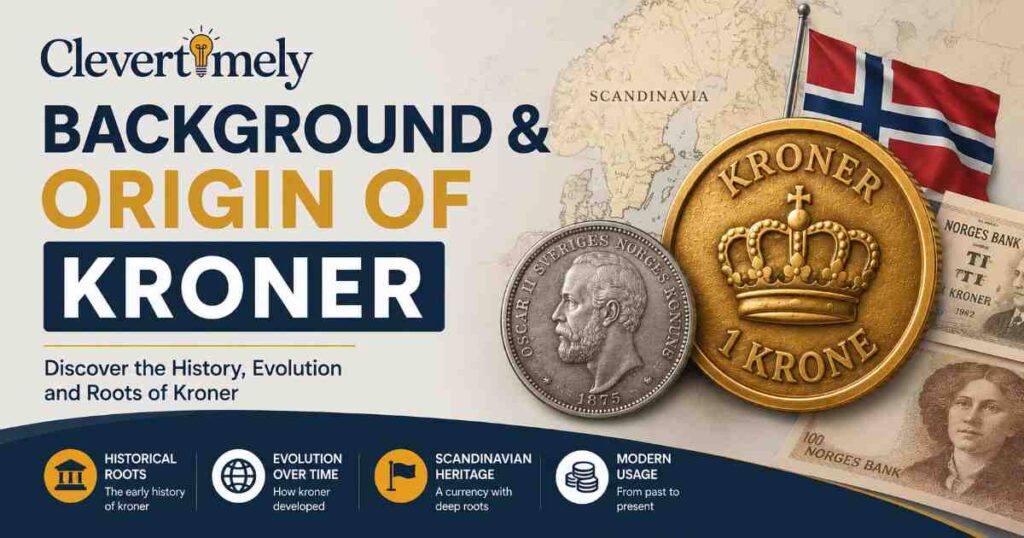
The story of kroner starts in ancient Rome. The word traces back to the Latin “corona,” meaning wreath or crown. This Latin root traveled through Middle Low German as “krōne” before entering the Scandinavian languages as “krone” and “krona.”
In the 1860s and 1870s, Scandinavian nations were working toward closer economic cooperation. In 1873, Denmark and Sweden formed the Scandinavian Monetary Union, introducing a shared currency called the krone/krona to replace older systems like the Danish rigsdaler and the Swedish riksdaler. Norway joined this union in 1875.
The name “crown” was not chosen at random. It carried deep symbolic meaning, connecting the currency directly to royal authority and national identity. At the time, all three countries were monarchies, and stamping a crown on the coin was a powerful statement of sovereignty and stability.
Although the Scandinavian Monetary Union formally dissolved in 1914 at the outbreak of World War One, each country chose to keep the name for its own national currency. That is why, more than a century later, Denmark uses the Danish Krone (DKK), Norway uses the Norwegian Krone (NOK), and Sweden uses the Swedish Krona (SEK).
This linguistic and historical consistency is why you will still see prices listed in “kroner” across Scandinavia today, from grocery stores in Oslo to ferry tickets in Copenhagen.
Read More: CYC Meaning in Text: What It Really Stands For in Chats Today
Usage in Different Contexts
The word “kroner” appears in several different situations. Knowing how to recognize and use it correctly in each context will help you communicate more clearly.
1. Financial Context
In financial markets and banking, kroner refers specifically to the official currency units traded on global foreign exchange markets. Investors, analysts, and economists use the term when discussing:
- Exchange rates between DKK, NOK, and currencies like USD or EUR
- Forex trading strategies involving Nordic currencies
- Norway’s oil-based economy and how it affects NOK value
- Denmark’s unique euro-pegged monetary policy
For example, you might read: “The Norwegian krone strengthened against the dollar as oil prices climbed.” In this context, kroner is purely a technical financial term.
2. Travel Context
For travelers heading to Denmark or Norway, kroner is a very practical, everyday word. Knowing what it means helps you budget correctly, avoid overpaying at currency exchanges, and understand local price tags.
Common travel uses include:
- Checking hotel prices listed in DKK or NOK
- Understanding restaurant menus and tipping customs
- Using local ATMs and understanding withdrawal fees
- Comparing exchange rates before departure
A helpful tip: always pay in local currency (kroner) rather than accepting dynamic currency conversion offers at card terminals, as those tend to include hidden markups.
3. Online Conversations
In social media posts, travel forums, Reddit threads, and comment sections, people frequently use the word kroner when sharing personal experiences in Scandinavia. You might see posts like:
- “This hotel cost me 1,200 kroner per night in Copenhagen. Totally worth it.”
- “Norway is expensive. A burger can cost 200 kroner!”
- “Just exchanged my dollars for kroner. The rate was decent.”
In these cases, kroner is used casually and conversationally, exactly the way someone might use the word “bucks” for dollars or “quid” for British pounds.
4. Informal Speech
In day-to-day speech among Danish and Norwegian speakers, “kroner” functions simply as the word for money. Children use it. Shopkeepers use it. It carries no special formality, much the same way English speakers just say “dollars” without thinking twice.
Meanings Across Platforms (Social Media Use)
Across different social media platforms, the word “kroner” appears in a variety of contexts. Here is a breakdown of how it tends to show up on each major platform:
| Platform | How “Kroner” is Used |
| Travel posts, price comparisons, Scandinavian lifestyle content | |
| TikTok | Budget travel videos, “this is how much things cost in Norway” reels |
| Finance subreddits (r/forex, r/travel), Nordic culture discussions | |
| Twitter/X | News headlines, currency commentary, economic updates |
| Travel groups, expat communities, personal finance pages | |
| WhatsApp/Texts | Casual mentions in group chats by travelers or expats |
One important point: despite occasional confusion online, kroner is not internet slang. It is not an acronym. It does not stand for anything else. If you see it used as though it has some secret meaning in a meme or comment, it is most likely a joke referencing money or Scandinavian culture.
Other Fields and Technical Usage
While kroner is primarily a currency term, it does appear in a few other areas worth noting.
History and Academia: Historians and economists studying Scandinavian monetary policy frequently reference kroner when writing about 19th and 20th century European economic history, including the Scandinavian Monetary Union and World War-era financial decisions.
Literature and Entertainment: Scandinavian novels, films, and TV shows (think Nordic noir crime dramas) regularly mention kroner in dialogue and plot lines. International audiences encountering these works often search for the word’s meaning afterward.
E-commerce and International Shopping: Online stores based in Denmark or Norway display prices in kroner. Shoppers from other countries need to understand the term to convert and compare prices effectively.
Cryptocurrency Discussions: Occasionally, people confuse “krone” or “kroner” with references to crypto tokens or coins because of the “crown” symbolism. There is no major cryptocurrency called “kroner,” and any such use would be informal or metaphorical.
Common Misconceptions and Mistakes
Many people make predictable errors when encountering the word kroner for the first time. Here are the most common ones and how to avoid them.
Misconception 1: All Scandinavian countries use “kroner.” This is not accurate. Denmark and Norway use “kroner” as the plural. Sweden uses “kronor,” and Iceland uses “kronur.” Using them interchangeably will cause confusion at currency exchange counters.
Misconception 2: Kroner is the same as the euro. Kroner and the euro are completely different currencies. Denmark is part of the European Union but has an opt-out from the euro and still uses its own Danish krone. Norway is not even an EU member. Neither country uses the euro as legal tender.
Misconception 3: Kroner is internet slang or a texting abbreviation. Kroner has no slang meaning. It is not Gen Z language, it is not a coded term, and it is not used as a shorthand for anything other than the actual currency.
Misconception 4: One kroner is worth close to one US dollar. Kroner is significantly weaker than the US dollar. One US dollar typically buys multiple kroner, not the other way around.
Correct Understanding
- Krone = one unit of the currency (singular)
- Kroner = multiple units (plural, used in Denmark and Norway)
- DKK = Danish Krone currency code
- NOK = Norwegian Krone currency code
- Kroner is not euro, not cryptocurrency, and not slang
Similar Terms and Alternatives
When discussing Scandinavian currencies, you will encounter a family of closely related terms. Understanding how they differ is essential for clear communication.
| Term | Country | Currency Code | Notes |
| Krone | Denmark, Norway | DKK, NOK | Singular form |
| Kroner | Denmark, Norway | DKK, NOK | Plural form (most common English usage) |
| Krona | Sweden | SEK | Swedish singular |
| Kronor | Sweden | SEK | Swedish plural |
| Króna | Iceland | ISK | Icelandic singular |
| Kronur | Iceland | ISK | Icelandic plural |
| Krone | Austria (historical) | N/A | Replaced by euro; no longer in use |
The word “crown” in English is sometimes used as a direct translation of krone when speaking informally. For instance, a writer might say “Denmark’s crown” instead of “the Danish krone” in a non-financial article.
How to Respond When Someone Mentions Kroner
If someone mentions kroner in conversation or in a text, the right response depends entirely on the context.
In a travel conversation: If a friend says “I spent 3,000 kroner in Oslo last weekend,” you can simply ask which currency they mean (DKK or NOK) and use a converter like Google or XE.com to understand the equivalent in your local currency. A helpful and natural response: “Oh nice, how much was that in dollars roughly?”
In a financial or news context: If you read that “the krone weakened against the dollar,” this signals a change in exchange rates that could affect import costs, tourism, or investment returns in the Nordic region. A knowledgeable response acknowledges the economic context: “That makes sense given where oil prices have been heading.”
In a casual social media comment: If someone posts “paid 800 kroner for dinner in Copenhagen,” you can engage by sharing your own experience or asking about the dining experience itself. No confusion needed, since the context makes the meaning clear.
Differences From Similar Words
Several words sound or look similar to “kroner” and cause frequent confusion. Here is a quick comparison to keep things clear.
Kroner vs. Corona: “Corona” is the Latin root from which krone is derived. It means crown. However, “corona” in modern usage is more commonly associated with the sun’s outer atmosphere or the virus that caused the global pandemic. Kroner and corona share an etymological ancestor but have entirely different contemporary meanings.
Kroner vs. Krona: Krona is the Swedish version of the same currency concept. The difference is essentially linguistic: krona is Swedish, krone is Danish and Norwegian. Both mean “crown,” and both trace back to the same Latin root.
Kroner vs. Kronor: Kronor is the Swedish plural, equivalent to kroner in Danish and Norwegian. If you are talking about multiple units of Swedish currency, “kronor” is the correct word.
Kroner vs. Kroon: Kroon was the former currency of Estonia, also derived from the same Latin root meaning crown. Estonia adopted the euro in 2011, so the kroon is no longer in use.
Relevance in Online Conversations and Dating Apps
In the age of international dating apps and global social media, people frequently encounter currency references from other countries. Someone on a dating app based in Norway or Denmark might reference their income, dinner costs, or weekend plans in kroner.
If you match with someone who mentions spending “400 kroner on a date last night,” they are talking about a moderate-to-decent dinner by Norwegian or Danish standards. Understanding what kroner means helps you gauge lifestyle, location, and cultural context from a simple number.
Similarly, in international friend groups on apps like Discord or group chats on WhatsApp, travelers and expats regularly drop currency references. Knowing that kroner refers to Scandinavian currency makes you a more informed and confident conversation partner.
It also prevents an embarrassing misunderstanding: kroner is not a nickname, not a coded phrase, and not a reference to anything other than the official currency.
Popularity and Trends Over Time
Interest in the word “kroner” has grown steadily in recent decades, driven by several overlapping factors.
Globalization and travel: As international travel to Scandinavia became more accessible, more people from non-Nordic countries started encountering the term. Norway and Denmark consistently rank among the world’s top destinations for nature tourism, cultural experiences, and quality of life rankings.
Scandinavian pop culture: The global popularity of Nordic noir crime dramas, Danish furniture design, and Swedish music exports brought Scandinavian words including “kroner” into broader cultural awareness.
Forex and investment interest: Norway’s substantial sovereign wealth fund and Denmark’s stable euro-pegged krone have made Nordic currencies attractive to global investors, increasing the financial media coverage of kroner-related topics.
Search trends: Online searches for “kroner meaning,” “what is a krone,” and “kroner to dollar” have remained consistently strong, with noticeable spikes every time oil prices shift or Scandinavian economic news makes international headlines.
In 2026, the Norwegian krone continues to attract attention because of its close relationship with global oil prices, while the Danish krone draws interest for its remarkable stability relative to the euro.
FAQs
1. What does kroner mean?
Kroner means “crowns” and is the plural form of krone, the official currency used in Denmark and Norway. It comes from the Latin word “corona,” meaning crown.
2. Which countries use kroner?
Denmark and Norway officially use kroner as their currency plural. Sweden uses “kronor” and Iceland uses “kronur,” which are closely related but distinct terms.
3. Is kroner the same as euro?
No. Kroner and the euro are completely separate currencies. Denmark has opted out of the euro despite being an EU member, and Norway is not an EU member at all.
4. What is krone in English?
Krone translates directly to “crown” in English, reflecting the royal symbolism that has been associated with Scandinavian currencies since the 19th century.
5. How much is 1 kroner in USD?
Exchange rates change daily, but as a general guide for 2026, 1 US dollar is roughly equivalent to around 6.4 Danish kroner (DKK) or approximately 10 to 11 Norwegian kroner (NOK). Always check a live converter like Google Finance or XE.com for accurate, real-time rates.
Conclusion
The word kroner carries more meaning than most people realize at first glance. It is not a slang term, not an internet trend, and not a passing fashion. It is a centuries-old word rooted in Latin, shaped by Scandinavian history, and actively used every single day by millions of people across Denmark and Norway.
Whether you are planning a trip to Bergen or Copenhagen, following Nordic currency markets, or simply trying to understand a reference in a conversation, knowing the kroner meaning gives you a practical edge. It helps you budget smarter, communicate more clearly, and appreciate the rich linguistic and economic history embedded in a word as simple as “crown.”
In 2026 and beyond, as the world grows more interconnected and Scandinavian culture continues to influence global trends in design, food, lifestyle, and sustainability, understanding words like kroner will only become more useful.
Next time you see a price tag in kroner or read about the Norwegian krone in a financial report, you will know exactly what it means and why it matters.

