

Introduction
You are scrolling through your group chat or TikTok feed and suddenly someone drops a message that starts with “PSA:” before saying something that may or may not be life-changing. You pause. You wonder if this is serious, funny, or something in between. If that sounds familiar, you are in exactly the right place.
PSA is one of those internet abbreviations that looks simple on the surface but carries a lot of weight depending on who says it, where they say it, and how. Whether you are a teenager navigating Discord servers and group chats, a parent trying to keep up with what your kids are saying online, or an adult who wants to sound fluent in digital communication, understanding PSA slang is genuinely useful in 2026.
This guide covers everything. What PSA originally meant, how it shifted into everyday internet language, how different generations use it, how platforms shape its meaning, where it goes wrong, and what you should know before you use it yourself. By the time you finish reading, PSA will feel completely natural to you.
What Does PSA Mean in Slang?
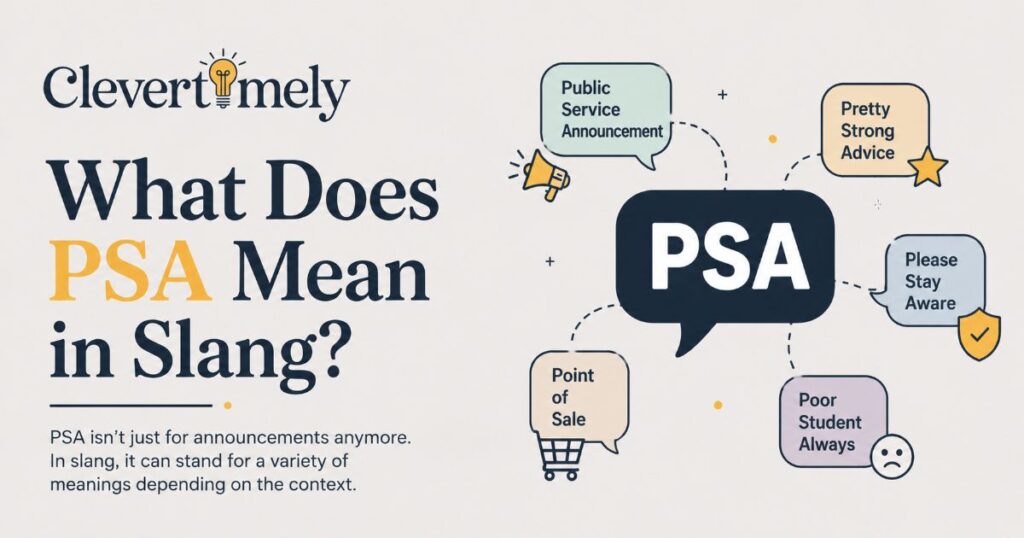
In slang and everyday online communication, PSA stands for Public Service Announcement. That is the short answer. The longer answer is that the meaning has stretched well beyond its formal roots.
When someone types “PSA:” before a message, they are essentially signaling: “Pay attention. What I am about to share matters.” But that importance can be completely genuine, mildly exaggerated, entirely ironic, or played for laughs. The letters stay the same. The tone does all the heavy lifting.
Here is a quick breakdown of how PSA functions in digital communication today:
| Context | What PSA Signals | Example |
| Serious warning | Genuine alert or important update | “PSA: That bridge is closed until Friday.” |
| Casual reminder | Friendly heads-up | “PSA: The homework is due at midnight.” |
| Hot take or opinion | Bold statement with flair | “PSA: Pineapple belongs on pizza and I will not apologize.” |
| Sarcasm or irony | Humor wrapped in fake urgency | “PSA: Your favorite band is not that deep.” |
| Community announcement | Practical info for a group | “PSA: Server maintenance tonight at 9 PM.” |
The common thread across all of these is attention. PSA is a three-letter hook designed to make people stop scrolling and actually read what comes next.
Read Also: What Does OFC Mean in Text: The Ultimate Guide (2026)
The Evolution of PSA from Formal to Slang
To understand why PSA became such a popular slang term, it helps to know where it came from.
The term “Public Service Announcement” has roots in mid-20th century broadcasting in the United States. Government agencies, health organizations, and nonprofits used television and radio spots to inform the public about things like fire safety, anti-smoking campaigns, emergency weather updates, and civic responsibilities. These were serious, structured messages with a clear purpose: inform the public about something important.
That format stayed mostly formal through the late 1990s. Then the internet arrived, and with it came forums, message boards, and early social platforms where people started adapting offline vocabulary for digital use. The term PSA appeared on early Reddit threads and web forums around the early 2000s, where users would type “PSA:” before sharing genuinely useful tips, warnings, or discoveries.
By the early 2010s, the usage had started to loosen. Users noticed that PSA carried a built-in sense of authority and urgency. It made a post feel important even if the content was trivial. That combination of fake seriousness and real communication became a tool for humor. By 2020, PSA was firmly established as both a genuine announcement starter and a comedic device across platforms like Twitter, Reddit, TikTok, and Instagram.
In 2026, it sits comfortably in both worlds at once.
Primary PSA Meaning: Public Service Announcement
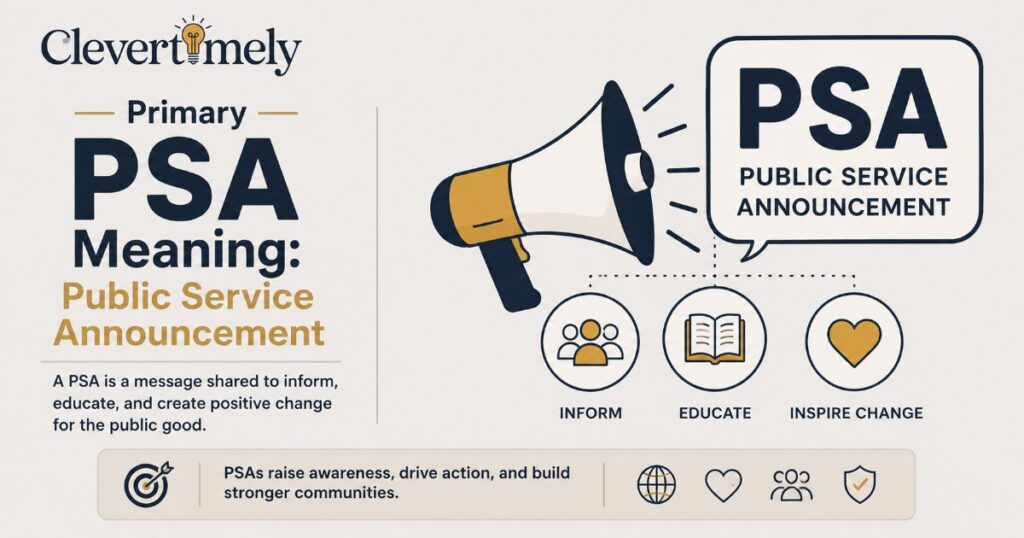
The core meaning has not changed. PSA still stands for Public Service Announcement, and that original intent is visible in many of the ways people use it online today.
When someone genuinely uses PSA to share helpful information, the structure mirrors the classic broadcast format. There is an audience, there is information worth sharing, and there is a sense that this message benefits everyone who reads it.
Practical, genuine PSA usage includes things like:
- Sharing road closures or construction updates with a local neighborhood group
- Alerting followers that a store or restaurant has changed its hours
- Warning friends about a known phone or email scam going around
- Reminding a class group chat about upcoming deadlines
- Flagging a product recall or safety issue in a parenting forum
In each of these cases, the person using PSA is being genuinely helpful. They have information, they want to share it with a group, and they want people to actually pay attention. The PSA prefix signals that this is not just small talk. It is worth reading carefully.
This usage works especially well in community-oriented spaces: neighborhood Facebook groups, work Slack channels, subreddits dedicated to specific hobbies, and school parent groups. The more community-focused the platform, the more likely PSA is being used with complete sincerity.
Alternative PSA Meanings in Slang Context
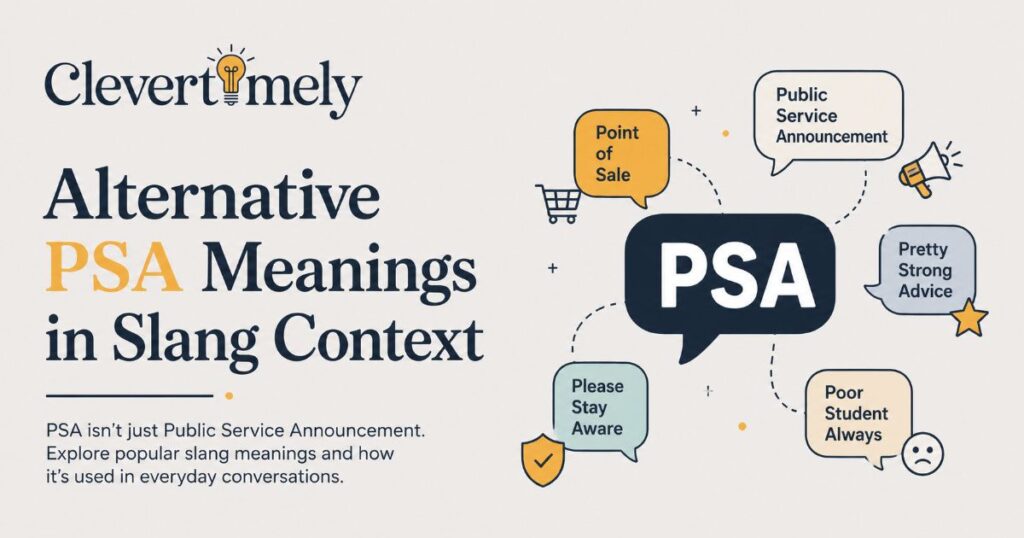
While Public Service Announcement remains the dominant interpretation, PSA has also developed a few alternative meanings in specific online communities.
Personal Shoutout Announcement is one variation you might spot on social media. In this usage, someone wants to publicly recognize or thank another person while making it feel more official or dramatic than a simple mention. “PSA: My best friend just got into her dream school and she deserves every single celebration.”
Personal Status Alert appears occasionally in gaming communities and casual group chats. Someone shares their current mood, situation, or status using PSA as a dramatic framing device. “PSA: I have been awake for 30 hours and I am running entirely on coffee and spite.”
Beyond these informal spin-offs, PSA also carries specific meanings in completely unrelated professional fields:
| Field | What PSA Stands For | Context |
| Medicine | Prostate-Specific Antigen | A blood test used in cancer screening |
| Collectibles | Professional Sports Authenticator | A card grading company; a PSA 10 card is mint condition |
| Legal | Public Service Agreement | A contract between government bodies |
| Aviation | Passenger Service Agent | Airport ground crew role |
If you see PSA in a conversation about trading cards, health screenings, or airport logistics, the meaning is entirely different from the social media slang version. Context is everything.
PSA Usage on Different Social Media Platforms
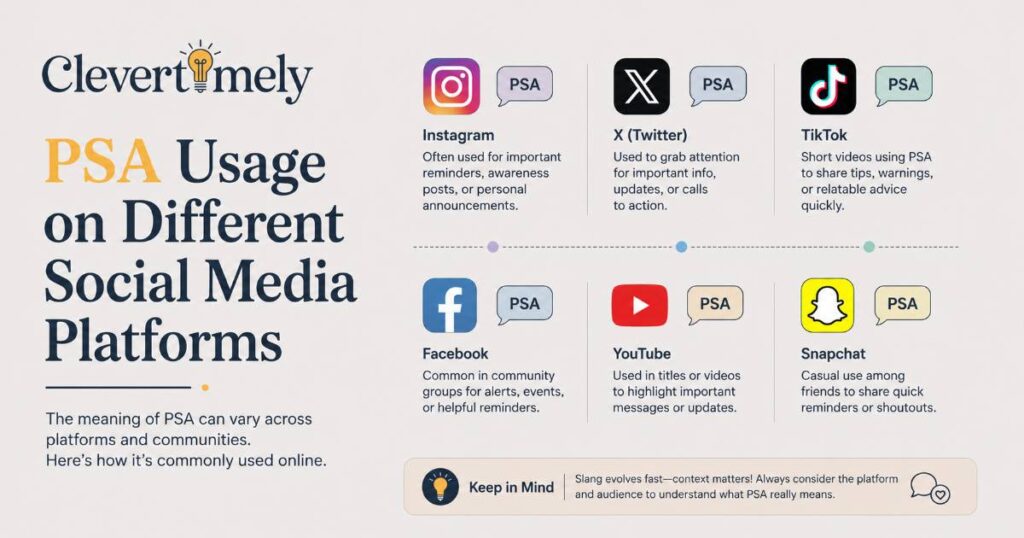
One of the most interesting things about PSA is how it adapts to each platform’s culture. The abbreviation stays the same but the energy behind it shifts depending on where you are.
TikTok is where PSA thrives most visually. Creators drop it in captions, text overlays, and voiceovers to create instant dramatic weight. “PSA: Romanticizing a mediocre situation is not a personality trait.” TikTok’s fast scroll speed means hooks matter enormously, and PSA functions as a perfect attention-stopper. The platform rewards declarative, bold statements, and PSA delivers exactly that energy.
Twitter / X has always been a natural home for PSA because the platform rewards brief, impactful statements. The fast-moving timeline means posts compete hard for attention, and PSA cuts through noise by signaling that what follows is worth slowing down for. News-adjacent communities, political commentators, and everyday users all deploy it regularly.
Reddit tends to see PSA used most sincerely. Subreddit communities focused on local news, consumer advice, health topics, and hobby spaces use PSA to share genuinely important updates. Moderators use it for rule changes. Members use it to flag scams or safety issues. The tone is usually informative rather than comedic.
Instagram uses PSA in Stories and Reels captions for a mix of humor and advice. Lifestyle creators use it to share relatable observations. Activists use it to raise awareness. The visual format means PSA often appears as bold text on a plain colored background, designed to stop scrolling immediately.
Discord is perhaps the most straightforward platform for PSA. Server admins and community managers drop it in announcement channels for genuinely practical updates: maintenance schedules, rule reminders, event announcements. Among friends in casual servers, it also takes on a humorous tone.
Snapchat uses PSA mostly in casual, personal ways. A quick Story with “PSA: Today is canceled, I am not okay” functions as both humor and emotional expression.
When to Use PSA in Text Messages and Chats
Knowing when to use PSA in text conversations comes down to reading three things: your relationship with the recipient, the importance of the message, and the tone you want to set.
PSA works well in texts and chats when:
- You are sharing something genuinely useful that benefits a group
- You want to inject light humor into an everyday reminder
- You are making a bold opinion sound deliberately dramatic
- You want to signal urgency without typing a long build-up
PSA works less well when:
- The message is directed at a single person in an intimate conversation (it can feel preachy)
- The information is not actually useful to anyone else in the chat
- You are addressing sensitive personal matters that deserve a softer approach
- You are speaking to someone who may not be familiar with internet slang
A good rule of thumb: PSA works best when the information genuinely serves an audience rather than just one person. The broadcast framing of the original Public Service Announcement still lives in the DNA of the slang version, which is why it lands best in group settings.
The Tone Spectrum: Serious to Ironic PSA Usage
One of PSA’s superpowers is its tonal range. It can operate anywhere on a spectrum from genuinely urgent to completely absurd, and the letters never change.
Here is how that spectrum looks in practice:
Fully Serious: “PSA: If you received an email from that address last week, do not click the link. It is a phishing scam.”
Gently Helpful: “PSA: The coffee shop on Fifth closes at 4 PM on Sundays now, not 6 PM. Saved you a trip.”
Casually Opinionated: “PSA: Buying the cheap version of a mattress is a decision your back will remember for a decade.”
Mildly Dramatic: “PSA: If you have not watched the second season yet, please log off until you do. Thank you for attending my announcement.”
Fully Ironic: “PSA: The ice cream flavor you wanted is definitely still in the freezer. I have no information about it disappearing.”
What makes this range possible is that PSA borrows credibility from its formal origins and then applies it to whatever follows, regardless of actual importance. When someone uses it ironically, the humor comes from the mismatch between the official-sounding label and the trivial content. That gap is the joke.
Understanding where a particular PSA falls on this spectrum is mostly about reading the content that comes after it and knowing the person or account delivering it.
Common PSA Mistakes and Misuses
Even a simple three-letter abbreviation can be used poorly. Here are the most common mistakes people make with PSA and why they create problems.
Overusing it. When every other message someone sends starts with PSA, the word loses all impact. It is supposed to signal importance or attention-worthiness. If everything gets that label, nothing does.
Missing the tone. A sarcastic PSA sent to someone who does not understand irony reads as a genuine warning. A sincere PSA sent in a context where humor is expected falls flat or comes across as preachy. Always consider your audience before deploying either version.
Using it to lecture. PSA can sound condescending when it comes from someone who is not actually in a position to be making announcements. “PSA: You should really exercise more” from an acquaintance is not a public service. It is unsolicited advice wrapped in authority-sounding packaging.
Treating it as a credibility marker. Some people assume that something labeled PSA is automatically trustworthy or factual. It is not. PSA signals that someone thought something was worth sharing. That is very different from the information being verified, accurate, or reliable.
Using it in the wrong context. A formal work email to senior leadership is generally not the right place for slang-style PSA usage, regardless of how casual your workplace is. Context awareness matters.
PSA and Generational Communication Differences
How people understand and respond to PSA depends significantly on generational familiarity with internet culture.
Gen Z (born roughly 1997-2012) treats PSA almost like punctuation. It is a casual, highly versatile tool they drop into messages without much thought. Both serious and ironic usage feel completely natural to this group. They understand immediately from context which version is being deployed.
Millennials (born roughly 1981-1996) were online early enough to watch PSA evolve from formal slang to the layered term it is today. Most millennials are comfortable with both sincere and humorous PSA usage, though they may be slightly more aware of the word’s formal origins.
Gen X (born roughly 1965-1980) has more mixed familiarity. Those active on social media and comfortable with internet culture generally recognize PSA and its casual uses. Those less plugged into online spaces may interpret it more literally and expect genuinely important information to follow.
Baby Boomers (born roughly 1946-1964) are most likely to read PSA in its traditional sense. When they see it, they may expect an actual public service announcement with real civic or health information. Ironic or humorous uses can land as confusing or even passive-aggressive to this demographic.
This generational gap matters most in mixed-audience spaces like family group chats, workplace communication, and community forums where people of different ages interact regularly.
PSA in Professional vs. Personal Contexts
The line between appropriate and inappropriate PSA usage shifts depending on whether you are in a professional or personal setting.
In personal contexts, PSA is almost always fair game. Friend groups, social media accounts, family chats, and hobby communities are all spaces where both sincere and ironic PSA works naturally. The informal register of these spaces matches the casual energy of the abbreviation.
In professional contexts, the answer is more nuanced.
PSA can work in professional settings when:
- The workplace culture is genuinely casual and informal
- You are sharing something useful with a team (a deadline, a policy change, a helpful resource)
- You are writing in internal Slack or Teams channels where informal language is accepted
- The announcement genuinely benefits everyone reading it
PSA tends to fall flat or create friction in professional settings when:
- You are communicating with external clients or senior leadership
- The topic is formal, sensitive, or legally significant
- Your organization has a traditional communication culture
- The ironic version lands in a space where it might be taken literally
A helpful test: would this message work equally well if you replaced PSA with “Please note” or “Important update”? If yes, the professional context is probably fine for PSA. If the swap reveals that the PSA version was doing something more playful or ironic, reconsider whether that tone is appropriate.
The Psychology Behind PSA Effectiveness
PSA works because it taps into some genuinely useful psychological principles around attention and communication.
Pattern interruption. Most social media content follows predictable formats. A message that starts with an all-caps acronym breaks that pattern and forces the brain to pay attention. The slight formality of PSA creates a micro-moment of “wait, is this important?” that makes people actually read what follows.
Borrowed authority. Public Service Announcements carry historical associations with trustworthy institutions. Government agencies, health organizations, and civic bodies used this format for generations. When someone uses PSA in casual conversation, they borrow a small fraction of that authority, making their message feel slightly more official than it otherwise would.
Social currency. In online communities, being the person who shares useful information earns social capital. PSA positions the sender as someone in the know, someone who caught something others might have missed, and someone worth following or listening to. That is a desirable identity in digital spaces.
Compression. Writing “Hey everyone, I just wanted to quickly let you know something important that I thought you should all be aware of” takes 19 words. PSA does the same job in three letters. In a communication environment where attention is scarce and scroll speeds are fast, that compression has real value.
Regional Variations in PSA Slang Usage
PSA originated in American broadcasting culture and spread globally through American-dominated social platforms. As a result, the United States remains where the term is most widely understood and most frequently used in casual slang contexts.
In the UK, PSA is understood but somewhat less common in organic slang usage. British internet users are more likely to adopt it in communities where American platform culture is dominant, such as Reddit, gaming servers, and Twitter.
In Australia and Canada, PSA usage largely mirrors American patterns due to shared English-language media ecosystems and platform overlap.
In non-English speaking countries, PSA appears primarily in English-language posts or in communities that engage heavily with American internet culture. Local equivalents exist in many languages, but PSA as a specific abbreviation tends to be understood in its English form even by non-native speakers who are active in global online communities.
On platforms like TikTok where content crosses borders rapidly, PSA has achieved something close to global recognition among younger users who regularly consume English-language content.
PSA Alternatives and Similar Acronyms
PSA exists in a broader ecosystem of attention-grabbing and information-sharing abbreviations. Understanding how it compares to similar terms helps you choose the right one for any situation.
| Acronym | Stands For | Key Difference from PSA |
| FYI | For Your Information | Neutral, informational, no urgency implied |
| ICYMI | In Case You Missed It | References something already shared or known |
| TL;DR | Too Long; Didn’t Read | Summarizes long content, placed at end |
| FWIW | For What It’s Worth | Softens an opinion, signals humility |
| IMO / IMHO | In My Opinion / In My Humble Opinion | Clearly frames personal perspective |
| NB | Nota Bene (Note Well) | More formal, academic contexts |
| ATTN | Attention | Workplace and email-heavy, very formal |
The clearest comparison is between PSA and FYI. PSA implies urgency and wants you to act on or internalize the information now. FYI is softer and more informational, suggesting the reader might find this useful at some point. “PSA: The deadline moved to Tuesday” creates urgency. “FYI: Deadlines sometimes move here” is background information.
ICYMI is similar to PSA but focused on recirculating existing content rather than announcing something new. It is backward-looking where PSA is forward-looking.
Cultural Context: Why PSA Became Popular Slang
PSA’s journey from government broadcasting to internet slang is a clean example of how digital culture repackages formal language for emotional and comedic purposes.
Several cultural forces drove this evolution. The rise of Twitter in the late 2000s created a communication environment where brevity was not just preferred but structurally required. Short acronyms thrived. At the same time, internet culture was developing a particular sense of irony that involved using formal or official-sounding language to describe completely mundane things. That ironic mode was the perfect incubator for PSA.
The format also fit naturally with how younger generations prefer to communicate: direct, confident, a little dramatic, and often self-aware about that drama. PSA lets you make an announcement while simultaneously signaling that you know you are making an announcement, which is exactly the kind of layered communication that resonates in communities built around meme literacy and shared cultural references.
By the time PSA reached TikTok, it had accumulated enough cultural weight to function as its own genre signal. Seeing PSA in a caption tells you something not just about the content but about the creator’s voice and relationship with internet culture.
PSA in Influencer and Creator Content
Content creators have turned PSA into a reliable engagement tool. It functions beautifully as a hook because it creates immediate expectation. When viewers or readers see PSA, they lean in slightly. Something is coming. They need to know what it is.
Creators use PSA in a few distinct ways:
As a genuine warning. Creators who discover a product defect, a misleading marketing claim, or a safety issue often lead with PSA to signal that this is important consumer information, not just a casual review.
As opinion delivery. Hot takes and strong opinions hit differently when framed as PSA. “PSA: Stop buying that brand of skincare. Here is what they are not telling you.” The PSA framing positions the creator as informed and the audience as in need of this information.
As comedic framing. Humor creators use PSA to set up jokes where the announcement turns out to be something absurd or unexpectedly mundane. The gap between serious framing and silly content is the punchline.
As community building. Regular PSA posts train an audience to pay attention, creating a Pavlovian pattern where followers know that PSA content is worth slowing down for. This increases engagement metrics and builds content identity.
The most effective creator PSAs combine genuine usefulness with strong voice. A PSA that teaches you something real while being entertaining keeps audiences coming back.
Gaming Communities and PSA Usage
Gaming communities have embraced PSA with particular enthusiasm, and for good reason. Online gaming involves constant coordination, shared information, and community management across large groups of players who need to communicate quickly and clearly.
In gaming contexts, PSA appears in several practical forms:
- Server announcements about maintenance windows, patch updates, or rule changes
- Warnings about known bugs, exploits, or game-breaking issues that affect other players
- Alerts about scammers, cheaters, or toxic players in a community
- Tips about time-limited events, sales, or in-game opportunities players might miss
Gaming communities also use PSA humorously, particularly in spaces with well-established in-jokes. “PSA: Picking [character name] in ranked is a crime and will be treated as such” is the kind of post that generates both genuine laughs and heated debate, which is essentially the ideal community engagement post.
Discord, the primary communication platform for gaming communities, has normalized PSA to the point where many servers have dedicated PSA channels or use the prefix as a standard format in announcement feeds.
Academic and Educational Settings
PSA usage in academic and educational contexts sits at an interesting intersection of formal and informal communication.
Students use PSA casually in class group chats, study Discord servers, and social media posts related to school life. “PSA: The midterm is open book but the professor’s definition of ‘open book’ is extremely generous, so read the syllabus.” This kind of post carries genuinely useful information wrapped in the casual tone students use with each other.
Teachers and educators have also started incorporating PSA as a communication format in some settings. A teacher posting “PSA: Office hours are moving to Thursday this week” in a class forum is using the abbreviation in a way that students find more engaging than a formal announcement would be.
In media literacy and digital citizenship curricula, PSA has become a teaching tool. Educators use the traditional meaning of Public Service Announcement as a project format, asking students to create their own PSAs on topics like cyberbullying, mental health awareness, or environmental issues. This creates an interesting loop where students are producing content in a format that their peers are simultaneously using as casual slang.
Mental Health and Support Communities
Online mental health and support communities use PSA in notably thoughtful ways. Because these spaces deal with sensitive topics, the tone of PSA usage tends to be more careful and sincere than in entertainment-focused spaces.
Common PSA uses in mental health communities include:
- Sharing newly published research about treatment options or resources
- Flagging changes to hotline numbers, resource availability, or support group schedules
- Warning community members about triggering content before it appears in a thread
- Reminding members of community guidelines, especially around sharing personal details
- Raising awareness about specific conditions during relevant awareness months
In these communities, PSA carries more weight than it does in entertainment spaces. Members trust that something labeled PSA is genuinely worth their attention. This creates a responsibility for people using the format: if you deploy PSA in a support community, the expectation is that the content is real, helpful, and appropriately considered.
Using ironic or humorous PSA in these spaces without clear tone markers can create confusion and unintentional harm, which is why community moderators often establish clear norms around how the format gets used.
Political and Social Justice Usage
PSA has become a significant format in political communication and social justice advocacy online. Activists and advocates use it to draw attention to policy changes, protest events, civic deadlines, and systemic issues that they believe deserve wider awareness.
“PSA: Voter registration closes in your state in three days. Here is the link.”
“PSA: That law passed last week. Here is what it means for people in these situations.”
This usage reflects the original spirit of Public Service Announcement most directly. The goal is genuinely to inform a public about something that affects them. The slang format makes the information feel more immediate and shareable than a formal press release or news article would.
At the same time, PSA in political contexts requires the same critical thinking it requires everywhere else. The label does not guarantee accuracy, and misinformation can be packaged as a PSA just as easily as factual information can. This is discussed more in the misinformation section below.
Brand and Corporate PSA Adoption
Brands and companies have noticed that PSA performs well as a content format and have incorporated it into their social media strategies with varying degrees of success.
When brands use PSA well, it tends to be because they are sharing genuinely useful information with their audience: product recalls, service outages, updated hours, important policy changes. These align with both the original meaning and the sincere slang usage of PSA.
When brands use PSA poorly, it usually because they are trying to manufacture urgency around promotional content that does not actually warrant urgent attention. “PSA: Our sale ends Sunday!” reads as performative. Audiences recognize immediately that this is advertising dressed in announcement clothing, and the format loses credibility.
The most effective brand PSA usage tends to be genuinely helpful, acknowledges something that went wrong (a sincere PSA about a service issue builds trust), or enters into established cultural conversations in ways that feel authentic rather than calculated.
The Dark Side: PSA in Misinformation
One important caveat about PSA that does not get discussed often enough: the format creates an aura of credibility that has nothing to do with whether the content is true.
Because PSA borrows from the authority of formal public announcements, people are slightly more inclined to believe, share, and act on information labeled PSA than information presented without that prefix. Bad actors know this. Misinformation campaigns, health hoaxes, and viral false claims frequently use PSA formatting to make unverified claims feel official.
“PSA: [Product] has been linked to serious health risks. Share before they delete this.”
“PSA: [Service] is being shut down. Download your data now.”
Neither of these is necessarily true, but the PSA framing makes people pause and consider sharing before they verify. This is a known pattern in how health misinformation and viral hoaxes spread.
Good digital literacy means applying the same skepticism to PSA-labeled content that you apply to anything else online. Ask where the information is coming from, whether it can be verified through a reliable source, and whether the urgency being created is real or manufactured. PSA is a formatting choice, not a fact-checking system.
Future of PSA Slang
Language online evolves fast, but PSA has shown remarkable staying power. Several factors suggest it will remain useful for the foreseeable future.
First, it solves a genuine communication problem. Capturing attention quickly in crowded digital spaces is genuinely difficult, and PSA provides an efficient solution. As long as people are competing for attention online, tools that help with that competition will persist.
Second, its tonal flexibility means it can adapt to changing cultural moods without becoming obsolete. Whether internet culture moves toward more sincerity or more irony in coming years, PSA can travel with it in either direction.
Third, it is already baked into platform cultures in ways that are hard to dislodge. Discord servers have PSA channels. TikTok creators have built content formats around it. Subreddits have PSA flairs. These structural integrations give the abbreviation a kind of institutional life that keeps it relevant even as individual trends cycle.
What may change is the precise tone and irony level of PSA usage. Each platform generation tends to add new layers of self-reference and meta-irony to shared formats. The PSA of 2030 might be used in ways that feel strange by today’s standards while still being recognizable as the same basic format.
PSA in Video Content and Live Streaming
Video creators and live streamers have developed their own conventions around PSA that are slightly different from text-based usage.
On YouTube, PSA often appears as a title prefix or early-video hook. Creators who spot a trend, debunk a myth, or flag an important development in their niche use PSA to signal that this video has immediate relevance. Viewers who follow channels closely know to watch PSA-titled videos sooner rather than later.
On Twitch and other live streaming platforms, PSA appears in chat as both a moderation tool and a community communication format. Streamers drop PSA announcements about schedule changes, charity streams, or important news relevant to their community. Chat members use it similarly, surfacing information they think the streamer or other viewers need.
In short-form video, PSA works as both the opening hook and the structural device. A 30-second TikTok that begins with “PSA:” and ends with the punchline or key information delivers complete communication value in a format that works perfectly for the platform.
Emoji and Symbol Combinations with PSA
In digital communication, PSA often appears alongside specific emojis and symbols that amplify its tone. Learning these combinations helps you read intent more accurately.
| PSA Combination | Tone Signal | Example |
| PSA + megaphone emoji | Genuine announcement, often positive | “PSA 📢 Free event this Saturday” |
| PSA + warning sign | Serious alert, potential danger | “PSA ⚠️ That link is a scam” |
| PSA + face with hand over mouth | Secret or surprising information | “PSA 🤭 The update dropped early” |
| PSA + laughing emoji | Clearly humorous, do not take seriously | “PSA 😂 I have been drinking coffee wrong for 30 years” |
| PSA + pointing finger | Directive or instructional tone | “PSA 👇 Read this before you order” |
| PSA in all-caps with no emoji | Ambiguous, read carefully for tone | Depends entirely on content |
The absence of emoji in a PSA message often signals either a very serious tone or a highly ironic one where any softening element would ruin the effect. Reading the surrounding context becomes even more important when no visual cues are present.
Cross-Platform PSA Etiquette
Because PSA is used differently across platforms, jumping between communities means adjusting your expectations and your own usage accordingly.
On Reddit, write your PSA clearly and include sources or context. The community tends to value substance over style, and an unsupported PSA will quickly be questioned in comments.
On TikTok, keep it punchy and front-load the key information. Viewers decide within the first two seconds whether to keep watching. Your PSA needs to be the hook, not a build-up to it.
On Twitter / X, brevity is your best friend. A two-sentence PSA with a clear point performs better than a multi-paragraph thread labeled as PSA.
On Discord, match the energy of the specific server and channel. A gaming server’s PSA culture differs from an academic study group’s PSA culture, even if they are both using the same abbreviation.
On Instagram, visual presentation matters as much as content. A well-designed Story slide that opens with PSA will outperform the same text buried in a long caption.
The core principle across all platforms: your PSA should deliver real value to the people reading it, whether that value is useful information, genuine humor, or both.
Teaching Kids About PSA Slang
If you are a parent, teacher, or caregiver who wants to help a young person understand PSA slang, the conversation is actually pretty manageable.
Start with the original meaning. Most young people, even if they have never thought about traditional Public Service Announcements, can understand the concept of an official-sounding message meant to inform a lot of people at once. Classic examples like “This is a test of the Emergency Broadcast System” or anti-smoking TV ads from decades past illustrate the format clearly.
Then explain how the internet borrowed that format and made it casual. Show examples of both sincere and ironic PSA usage and discuss how to tell them apart. The key skill is context-reading, and building that skill requires looking at who sent the message, where it was sent, and what came after the PSA prefix.
The most important lesson is the misinformation point. Help young people understand that PSA is a formatting choice and carries no automatic truth value. Teaching critical thinking about PSA-labeled content is part of broader digital literacy education that pays dividends across all their online interactions.
International PSA Usage Patterns
Outside the United States, PSA usage follows some interesting patterns that reflect how American internet culture travels globally.
In English-speaking countries with heavy American cultural influence, PSA functions almost identically to how it does in the US. British, Canadian, and Australian internet users largely understand both sincere and ironic PSA without needing explanation.
In European countries where English is widely spoken as a second language, PSA is recognized primarily in its English-language internet context. Users active in international communities on Reddit, Discord, and TikTok encounter PSA regularly and absorb its meaning through repeated exposure.
In Asian markets, particularly South Korea and Japan, which have highly developed domestic internet cultures, PSA appears primarily in spaces that engage heavily with English-language content. Local equivalents exist in Korean and Japanese online slang, but PSA itself tends to remain an English-language term even when used in bilingual communities.
On global platforms like TikTok where content travels across language barriers rapidly, PSA has achieved meaningful international recognition among younger users who consume multi-language content. Its brevity and visual distinctiveness help it communicate even when full language comprehension is limited.
PSA and Accessibility Considerations
One aspect of PSA usage that does not get much attention is how it functions for people with disabilities or those using assistive technology.
Screen readers, used by people with visual impairments, typically read PSA as three individual letters: P, S, A. For people familiar with internet slang, this is immediately recognizable. For those less familiar with online culture, the abbreviation may not land as clearly as the writer intended. Spelling out “Public Service Announcement” at least once before using PSA, or including context immediately after, makes content more accessible.
For people with cognitive disabilities or neurodivergent users who process text literally, ironic PSA usage can create genuine confusion. When sarcasm is the intent, explicit tone markers such as humor labels, emojis, or contextual cues become especially important.
In mental health communities and disability-focused spaces, many community guidelines already address this by establishing norms around clear communication and explicit tone labeling. These practices make the community more accessible for everyone and are worth adopting more broadly.
Frequently Asked Questions
What does PSA stand for in texting?
In texting and online chat, PSA stands for Public Service Announcement. It signals that the message that follows is worth paying attention to, whether the content is genuinely important, casually helpful, or humorously dramatic.
Is PSA only used seriously or can it be funny?
PSA is used both seriously and humorously, often in the same online communities. The tone depends entirely on context, content, and the relationship between the sender and the audience. Ironic and sarcastic PSA posts are extremely common, especially on platforms like TikTok and Twitter.
Can I use PSA in professional work messages?
Yes, in the right workplace context. PSA works well in informal internal channels like Slack when sharing genuinely useful information with colleagues. Avoid it in formal communications, client-facing messages, or conversations with senior leadership where a more professional tone is expected.
What’s the difference between PSA and FYI?
PSA implies urgency and signals that the information demands immediate attention. FYI is neutral and informational, suggesting the reader may find the content useful without implying they need to act on it right away. PSA commands attention; FYI offers background context.
Do older people understand PSA slang?
It depends on their familiarity with internet and social media culture. Tech-savvy older adults who are active online generally recognize PSA and its casual uses. People less connected to digital spaces may interpret PSA more literally and expect genuinely important civic information to follow.
Is PSA appropriate for serious topics like mental health?
Yes, and it is used regularly in mental health communities for sharing resources, flagging important information, and issuing content warnings. The key is sincerity and care. In these spaces, PSA typically carries more weight than in entertainment contexts, so use it thoughtfully and always ensure the content is genuinely useful and considerate of your audience.
Conclusion
PSA has come a long way from government radio spots and anti-smoking television ads. Today, it is one of the most flexible and widely understood abbreviations in the internet slang ecosystem, capable of carrying genuine urgency, casual helpfulness, dry irony, or outright comedy depending on who is using it and where.
What makes PSA work is the same thing that made Public Service Announcements work in traditional media: it creates a signal that says “this is worth your attention.” The difference is that in 2026, that signal applies to everything from genuine safety warnings to jokes about pizza toppings, and the audience is expected to tell the difference through context rather than institutional authority.
For teens navigating group chats and social media, PSA is practically a native language element at this point. For adults trying to stay current with digital communication, it is one of the more useful abbreviations to understand because it shows up constantly across platforms, topics, and tonal registers.
The practical takeaway is straightforward. When you see PSA, read what comes next before deciding how seriously to take it. When you use PSA, make sure you know whether you are being sincere or ironic and that your audience can tell the difference. And regardless of how PSA-labeled content makes you feel, always verify important information through reliable sources before acting on it or sharing it further.
That combination of open-mindedness, contextual reading, and healthy skepticism is genuinely good digital citizenship. And in a way, that is its own kind of public service.

