
If you spend any time online, you’ve probably seen the letters “OP” pop up in a comment, a group chat, or a gaming lobby. Maybe a friend called your outfit “OP.” Maybe someone on Reddit mentioned “the OP” and you had no idea who they meant. Either way, you’re not alone.
OP is one of those small slang terms that carries a surprisingly large amount of meaning, and that meaning changes depending on where you see it. It can be a compliment, a gaming complaint, a Reddit reference, or even a nod to something being unfairly good. This guide breaks down every common meaning of OP, where it came from, how people use it today, and how you can use it correctly without sounding out of touch.
This guide walks through every setting where OP shows up, from gaming lobbies to Reddit threads to your group chat, so you can tell the difference in seconds instead of pausing mid-conversation to figure it out.
By the end, you’ll never have to guess what OP means again.
What OP Means in Slang
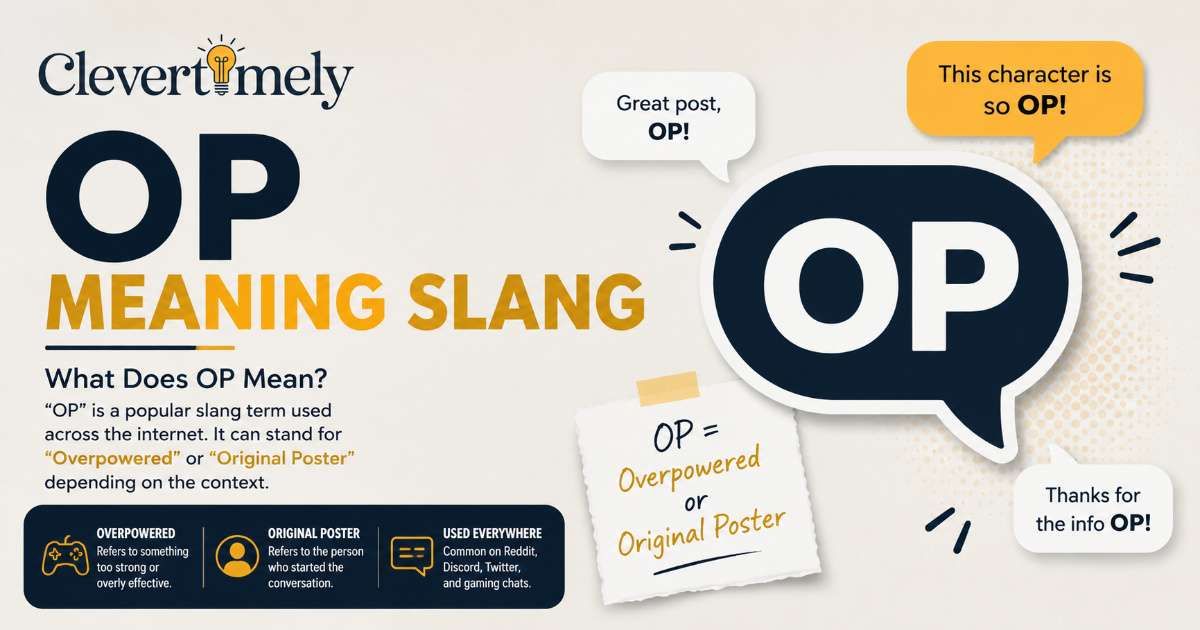
At its core, OP is short for two very different things, and context decides which one applies:
- Original Poster – the person who started a thread, post, or discussion online
- Overpowered – something (a character, skill, move, or person) that is unfairly strong, dominant, or impressive
There’s also a third, less common use borrowed from street slang, where OP stands for “opposition” or refers to a rival person or group.
The trick to understanding OP is simple: look at where the conversation is happening. Forums and comment sections usually mean “original poster.” Gaming chats and casual texting usually mean “overpowered.” Once you get a feel for the platform, the meaning becomes obvious almost instantly.
| Meaning | Common Setting | Example |
| Original Poster | Reddit, forums, comment threads | “OP never responded to the question.” |
| Overpowered | Gaming, texting, social media | “That new character is so OP.” |
| Opposition/Rival | Street slang, some regional dialects | “Watch out, that’s their OP.” |
OP Meaning in Texting and Chat Apps
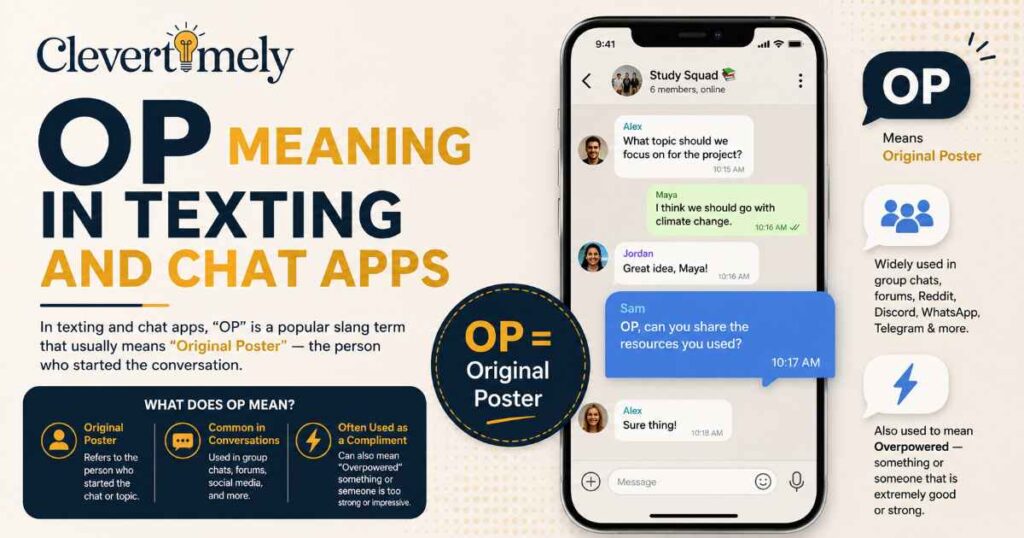
In texting and apps like iMessage, WhatsApp, or Discord, OP is most commonly used as a short way to say something is impressive, extreme, or next-level good.
If a friend sends a photo of a sunset and you reply “that’s OP,” you’re saying it looks amazing. If someone shares a story about acing a test with zero studying, “bro is OP” means they’re operating on a different level.
In group chats, though, OP can sometimes flip back to its original meaning, referring to whoever started the group or the person whose message everyone is replying to. This dual meaning is exactly why context matters so much with this word.
Common texting uses include:
- Complimenting someone’s skill, looks, or achievement
- Reacting to a surprising or impressive video or photo
- Referring to the person who created a group chat or thread
- Expressing mild disbelief at how good or strong something is
Read More: What Does PMO Mean? A Deep Dive into the Project Management Office
OP Meaning on Social Media Platforms
Social media is where OP really took off outside of gaming circles. On platforms like Twitter/X, Instagram, and TikTok, the word shows up constantly in comment sections.
On Twitter/X, OP still frequently refers to the original poster, the account that started a viral tweet or thread. You’ll often see replies like “OP is not responding” or “OP clearly didn’t think this through.”
On TikTok and Instagram, OP leans more toward the “overpowered” or “impressive” meaning. A viral dance, a glow-up transformation, or a clever life hack might get comments like “this edit is OP” or “her comeback was OP.”
Here’s a simple breakdown by platform:
| Platform | Typical OP Meaning |
| Twitter/X | Original Poster |
| Original Poster | |
| TikTok | Overpowered/impressive |
| Overpowered/impressive | |
| Discord | Both, depending on the server |
Understanding which platform you’re on is often the fastest way to decode the intended meaning.
OP in Online Gaming
Gaming is where the “overpowered” meaning of OP truly originated, and it remains the most technical and widely recognized use of the term.
In multiplayer games, OP describes a character, weapon, ability, or strategy that gives players an unfair advantage compared to everything else in the game. When something is OP, it usually needs a “nerf,” meaning developers weaken it to restore balance.
Common gaming examples:
- “That sniper rifle is way too OP, it needs a nerf.”
- “The new hero is OP right now, everyone is picking them.”
- “This build is OP against low-level players.”
Game balance discussions are full of this term because competitive fairness depends on no single option dominating the meta. When a community calls something OP, developers often take notice, since repeated complaints usually lead to a patch.
Gamers also use OP as a compliment for skilled players. Calling someone “an OP player” means they’re exceptionally talented, not necessarily that they’re exploiting a broken game mechanic.
OP on Reddit and Online Forums
Reddit is the platform most responsible for keeping the “Original Poster” meaning alive and mainstream. On Reddit, OP almost always refers to the user who created the original post in a thread.
You’ll see phrases like:
- “OP, can you clarify what happened next?”
- “Not OP, but I had a similar experience.”
- “OP deleted their account after this blew up.”
This usage extends to other forums and message boards as well, including older platforms like 4chan and niche community forums, where OP has been standard shorthand for decades.
On Reddit specifically, OP carries a bit of social weight. Being “OP” in a thread often means you’re expected to answer follow-up questions, provide updates, or clarify details, especially in advice or storytelling subreddits.
Alternate Meanings of OP
While “Original Poster” and “Overpowered” dominate everyday use, OP has picked up a few other interpretations over time:
- On Point – used to describe something accurate or well-executed
- Over Political – describing someone seen as overly aggressive about political opinions
- Opposition/Opp – street slang referring to a rival, enemy, or competing group (sometimes spelled “opp” with two Ps)
- Operator – used in military or tactical gaming contexts to describe a specialized character class
These meanings are far less common than the top two, but they do appear, especially in niche communities, regional slang, or specific game genres like tactical shooters.
Examples of OP in Real Conversations
Seeing OP in real sentences makes the different meanings click much faster. Here are examples across contexts:
Gaming chat: “This weapon is actually OP, I’ve won every match with it today.”
Reddit thread: “OP, I think you’re overreacting a bit, but I understand why you’re upset.”
Texting a friend: “Did you see her new haircut? It’s OP.”
Twitter reply: “OP posted this three years ago and it’s still relevant.”
Group chat: “Whoever is OP of this chat needs to change the name, it’s outdated.”
Sports commentary style: “That comeback in the fourth quarter was OP, nobody saw it coming.”
Notice how the surrounding words and platform give away the intended meaning almost every time, even without extra explanation.
History and Evolution of OP Slang
OP has a longer history than most people realize, and it developed along two separate paths before merging into the internet-wide term it is today.
The “Original Poster” meaning dates back to early internet forums and bulletin board systems in the 1990s and early 2000s. As threaded discussions became the standard way people communicated online, shorthand was necessary to refer back to whoever started a topic without retyping their username every time.
The “Overpowered” meaning grew separately out of gaming communities, particularly competitive multiplayer titles where game balance became a constant topic of discussion. As esports and online multiplayer gaming exploded in popularity through the 2000s and 2010s, “OP” became standard vocabulary among players worldwide.
By the mid-2010s, both meanings had spread into mainstream internet culture through streaming platforms, YouTube gaming commentary, and meme culture. Social media accelerated this even further, allowing gaming slang to blend with everyday texting and forum culture until the lines between the two meanings became something you had to figure out from context rather than definition alone.
Today, in 2026, OP continues to evolve. It’s increasingly used sarcastically, ironically, or as a general intensifier, similar to how words like “iconic” or “unreal” get stretched beyond their literal meaning in casual conversation.
Similar Slang Words to OP
OP doesn’t exist in isolation. Several other slang terms overlap with it in meaning or usage style, depending on the context.
| Slang Term | Meaning | Similar Use to OP |
| GOAT | Greatest of all time | Used to describe someone exceptionally skilled |
| Broken | Something unfairly strong in games | Nearly identical to “overpowered” |
| Meta | Most effective tactics available | Related to what’s considered OP in a game |
| Cracked | Extremely skilled at something | Complimentary, similar to “OP player” |
| Nerf | Weakening something that’s too strong | The fix for something being OP |
| TS | The person who started a thread (Topic Starter) | Similar to OP in forum contexts |
Understanding these related terms helps place OP within the broader landscape of internet and gaming slang, since many of these words are used together in the same sentence or conversation.
Why People Use OP
Slang like OP survives because it’s efficient. Instead of typing out “the person who originally posted this” or “this is unfairly strong compared to everything else,” people can compress the idea into two letters.
Beyond convenience, there are a few deeper reasons OP has stuck around:
- It signals community membership. Using gaming or internet slang correctly shows you’re plugged into the culture.
- It’s flexible. The same word can be praise, criticism, or a neutral reference depending on tone.
- It’s fast. Texting and commenting favor short, punchy words over full sentences.
- It transcends platforms. Whether you’re gaming, browsing Reddit, or scrolling TikTok, OP works everywhere.
This flexibility is part of why the term has lasted decades instead of fading out like so many other short-lived slang trends.
Language experts often point out that slang thrives when it fills a gap that formal language doesn’t cover well. “Overpowered” as a single word doesn’t quite capture the mix of admiration and mild annoyance that gamers feel about a broken weapon, but “OP” does the job instantly. That’s a big part of why it caught on so widely and why it keeps getting reused across new platforms and new generations of internet users.
How to Respond When Someone Says OP
If someone calls you or something “OP,” how you respond depends on the tone and context. Here are a few natural ways to reply:
- If it’s a compliment: “Haha thanks, I’ll take it” or “OP status confirmed.”
- If it’s about game balance: “Yeah, it definitely needs a nerf” or “I know, I’ve been abusing it.”
- If it refers to you as the original poster: Simply respond to the question or comment being asked, since you’re expected to engage.
- If it’s sarcastic: Play along with a light joke rather than taking it seriously.
Reading the tone of the conversation is more important than the literal word itself. A playful “you’re so OP” between friends is very different from a frustrated “this is OP” complaint in a gaming lobby.
When NOT to Use OP
While OP is common and generally harmless, there are situations where it doesn’t fit well:
- Professional emails or work communication. OP can come across as unclear or too casual.
- Formal writing or reports. Slang terms reduce clarity and professionalism in formal contexts.
- Conversations with people unfamiliar with internet culture. Older relatives or new acquaintances may not understand the reference.
- When precision matters. If you genuinely mean “the original poster” in a serious discussion, it may be clearer to spell it out fully the first time.
Using OP outside of casual digital spaces, like gaming chats, social media, texting, or forums, can create confusion rather than the quick understanding it’s meant to provide.
OP Popularity Around the World
OP started in English-speaking online spaces, particularly American and international gaming and forum communities, but it has since spread globally thanks to the universal nature of online gaming and social media.
- In the United States, OP is used heavily across gaming, texting, and social media, often as praise or a gaming balance complaint.
- In the United Kingdom, the term is common in gaming and forum culture, with similar usage patterns to the US.
- In Southeast Asia, particularly in mobile gaming communities, OP is extremely common due to the popularity of competitive mobile titles.
- In non-English speaking countries, OP is frequently borrowed directly into local gaming slang without translation, since gaming terminology often stays in English regardless of region.
Because gaming and social platforms are global, OP has become one of the more universally recognized pieces of internet slang, even among people who don’t speak English as a first language. Streamers, esports commentators, and influencers who broadcast to international audiences have played a large role in this spread, since viewers pick up terminology directly from the content they watch rather than from formal language lessons. This is one reason OP feels so consistent across borders compared to other slang that tends to stay more regional.
FAQs About OP Meaning Slang
What does OP mean in gaming?
In gaming, OP means “overpowered.” It describes a character, weapon, or strategy that’s unfairly strong compared to everything else in the game.
Can OP mean Original Poster and Overpowered in the same conversation?
Yes, especially in gaming forums or Discord servers, where someone might reference the original poster’s opinion about an overpowered character in the same thread.
Is OP slang appropriate in professional settings?
No, OP is casual internet slang and is best avoided in emails, reports, or formal workplace communication.
How do I know which meaning of OP is intended?
Look at the platform and context. Forums usually mean “original poster,” while gaming and texting usually mean “overpowered.”
Can OP have other meanings?
Yes, less common meanings include “on point,” “over political,” and “opposition,” though these appear far less often than the two main definitions.
Conclusion: Mastering OP Slang in 2026
OP is a small word that carries a lot of weight across today’s digital world. Whether it means “original poster” on Reddit, “overpowered” in a gaming lobby, or a quick compliment in a group chat, context is always the key to understanding it correctly.
Now that you know the history, the platform-specific meanings, and the best ways to use and respond to OP, you’re ready to use it confidently without any confusion. Slang like this will keep evolving, but the core idea behind OP, something or someone standing out from the rest, isn’t going anywhere anytime soon.

