

Introduction
If you have ever worked in a corporate environment or been part of a large project team, you have likely come across the acronym PMO. But what does PMO mean exactly, and why does it matter so much to organizations around the world? In this guide, we break down everything you need to know about the PMO, from its definition and core responsibilities to the types of PMOs, how they serve different industries, and why they are a cornerstone of effective project governance and business strategy.
Whether you are a project manager, a business executive, or simply someone trying to make sense of how modern organizations manage complex work, this article has you covered.
What Does PMO Mean? – Defining the Project Management Office
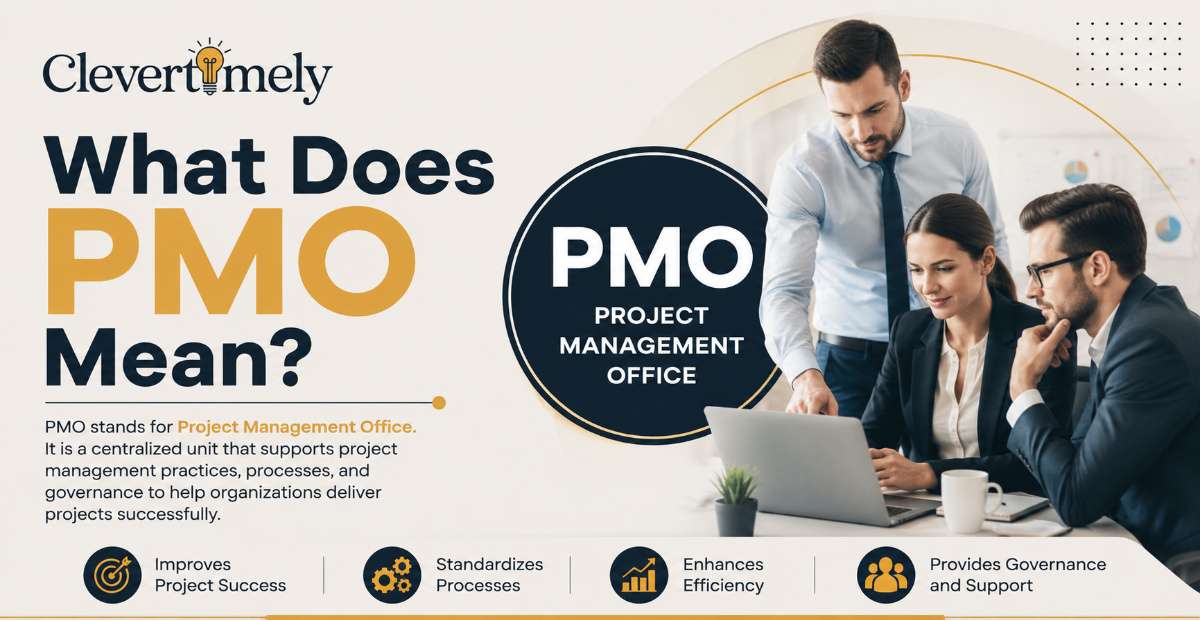
PMO stands for Project Management Office. It is a centralized group, team, or department within an organization that is responsible for defining, maintaining, and standardizing the practices, processes, and standards used to manage projects.
Think of the PMO as the command center for project management activity across a business. While individual project managers oversee specific projects, the PMO steps back to look at all projects as a whole, ensuring that every initiative follows consistent methods and contributes to the organization’s broader goals.
According to the Project Management Institute (PMI), a PMO is essential for enterprises seeking to centralize and coordinate the management of projects throughout their life cycles. At its core, the PMO serves as a single source of documentation, guidance, and performance metrics for project execution across the business.
The concept of a project management office is not new. The term was first used in a publication as far back as 1939, and the 1950s version of the PMO closely resembles what modern organizations use today. Over the decades, the PMO has evolved from a simple administrative support function into a strategic driver of business performance.
PMO vs. Project Manager: What Is the Difference?
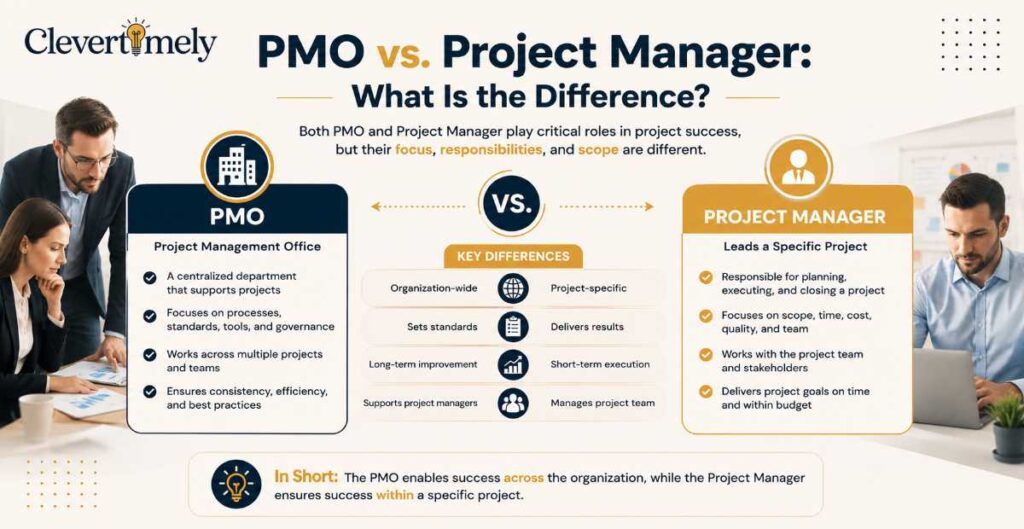
A common point of confusion is the difference between a PMO and a project manager. Here is a quick breakdown:
| Feature | Project Manager | Project Management Office (PMO) |
| Scope | One specific project | All projects across the organization |
| Focus | Day-to-day execution | Standards, governance, and strategy |
| Accountability | Delivery of one project | Portfolio-level performance |
| Role type | Operational | Strategic and operational |
| Reporting | Often to the PMO or department head | Often to a VP or C-suite executive |
A project manager focuses on planning and delivering a single project within defined scope, time, and budget. The PMO, on the other hand, focuses on creating the environment in which all project managers can succeed.
The PMO Meaning – Key Responsibilities
Now that we understand what PMO means, it is worth exploring what a PMO actually does. The responsibilities of a project management office vary depending on the type and size of the organization, but several core functions appear consistently across industries.
Read More: TSS Meaning in Text: What It Really Means in 2026 (Clear Guide + Real Examples)
Core PMO Responsibilities
1. Establishing Project Management Standards The PMO defines the frameworks, methodologies, tools, and templates that project managers use across the business. This ensures consistency no matter who is running a project or which team is involved.
2. Governance and Oversight One of the most important functions of the PMO is providing governance. This means setting up clear decision-making processes, reviewing project performance, conducting stage-gate reviews, and ensuring accountability at every level.
3. Resource Management The PMO helps allocate shared resources, including people, technology, and budgets, across competing projects. It ensures that resources are deployed where they will deliver the most value.
4. Risk Management By maintaining a portfolio-level view of all active projects, the PMO can identify risks early, escalate issues to senior leadership, and help teams develop mitigation strategies before problems become costly.
5. Performance Tracking and Reporting The PMO monitors key performance indicators (KPIs) across all projects, producing regular reports for stakeholders and leadership. This creates visibility and enables data-driven decision-making.
6. Training and Capability Building Many PMOs run training programs for project managers and team members. By investing in skills development, the PMO raises the overall level of project management maturity within the organization.
7. Process Improvement and Lessons Learned The PMO captures lessons learned from completed projects and uses that knowledge to continually improve processes and practices for future initiatives.
Types of PMOs
Not all project management offices are the same. The right type of PMO for any given organization depends on its size, culture, industry, and project management maturity. The PMBOK Guide, published by the Project Management Institute, identifies three primary types of PMOs.
1. Supportive PMO
A supportive PMO acts more like a consultant than a controller. It provides templates, best practices, training, and access to historical project data. Project managers retain a high degree of autonomy and are free to adapt the tools and guidance provided by the PMO to suit their specific needs.
This model works well in organizations where project managers are experienced, capable, and largely self-directed. It is best suited for companies with a mature project management culture that needs a centralized knowledge hub rather than heavy oversight.
Key characteristics:
- Acts as a resource center and knowledge repository
- Provides templates, tools, and training
- Low degree of control over individual projects
- Best for experienced, autonomous project teams
2. Controlling PMO
The controlling PMO goes a step further. It not only provides support but also requires project teams to comply with specific processes, frameworks, and reporting standards. Teams must use approved methodologies, submit defined documentation, and follow stage-gate review processes.
This type of PMO balances standardization with flexibility. It mandates the framework but allows individual project managers some freedom in how they work within it. Controlling PMOs are especially common in regulated industries such as financial services, healthcare, and pharmaceuticals, where governance and audit trails are critical.
Key characteristics:
- Enforces use of approved methodologies and tools
- Requires compliance with defined standards
- Moderate level of control
- Suitable for organizations needing consistency with some flexibility
3. Directive PMO
The directive PMO represents the highest level of centralization and control. In this model, the PMO takes direct responsibility for managing and delivering projects. Project managers are employed by or report directly to the PMO, and the PMO itself is accountable for project outcomes.
This approach is common in large enterprises and government agencies where consistent delivery standards are non-negotiable and where strategic alignment between projects and organizational objectives is a top priority.
Key characteristics:
- Directly manages and executes projects
- Full control over project delivery
- Project managers report to the PMO
- Best for large, complex, or highly regulated environments
PMO Types at a Glance
| PMO Type | Control Level | Best For | Key Feature |
| Supportive | Low | Experienced teams | Knowledge and templates |
| Controlling | Moderate | Regulated industries | Compliance and standards |
| Directive | High | Large enterprises | Direct project management |
What Does PMO Mean For in Different Industries
The PMO acronym carries the same fundamental meaning across all sectors, but how it is applied varies significantly depending on the nature of the industry.
Information Technology and Software
Technology companies use PMOs to manage product roadmaps, IT infrastructure upgrades, digital transformation programs, and software development cycles. A well-run PMO in tech helps coordinate multiple agile teams, manage dependencies across platforms, and ensure that technology investments align with business objectives.
Healthcare and Pharmaceuticals
In healthcare and pharma, a PMO is critical for managing clinical trials, regulatory submissions, hospital system implementations, and facility changes. The documentation and audit trail requirements in this sector make the controlling or directive PMO model especially valuable.
Construction and Engineering
Construction firms rely on PMOs to manage complex timelines, track budgets, coordinate subcontractors, and mitigate risks on large infrastructure projects. A PMO in this context provides the structure needed to keep multi-year projects on track and within budget.
Financial Services and Banking
Banks and financial institutions use PMOs to govern regulatory change programs, digital banking initiatives, and compliance-driven projects. The need for strict audit trails and governance makes the PMO indispensable in this sector.
Government and Public Sector
Government agencies depend on PMOs to oversee large-scale public programs, ensure transparency and accountability, and manage cross-departmental initiatives that span multiple years and involve numerous stakeholders.
Consulting and Professional Services
Consulting firms use PMOs to track billable project work, ensure quality delivery across client engagements, and manage resource allocation across multiple concurrent projects.
What Does PMO Mean for Businesses?
Beyond the technical definition, the PMO has a very real and measurable impact on business performance. Here is what a well-functioning project management office delivers for the organizations that invest in one.
Improved Project Success Rates
Research consistently shows that organizations with mature PMOs have higher project success rates. According to the State of Project Management Report 2025, 82% of organizations now operate one or more PMOs. High-performing organizations with well-established PMOs report up to 300% ROI within the first year of implementation.
Better Resource Utilization
Without a PMO, resources are often siloed within departments, leading to duplication of effort and gaps in capacity. The PMO provides a bird’s-eye view of resource demand and supply, enabling smarter allocation and reducing waste.
Increased Executive Visibility
Most PMOs report to senior leadership, with 50% reporting directly to a C-level executive, according to PM Solutions’ 2022 State of the PMO report. This gives executives real-time visibility into the health of the project portfolio and enables faster, more informed decisions.
Faster and More Consistent Delivery
When every project follows the same standards, teams can move faster. There is no need to reinvent the wheel on each new project because the frameworks, templates, and tools are already in place. Consistency reduces delays, miscommunications, and rework.
Reduced Risk
By maintaining oversight across all active projects, the PMO can spot early warning signs of trouble, escalate issues before they become crises, and ensure that risk management plans are in place and being followed.
The Importance of PMO Acronym and Project Success
The PMO acronym has become synonymous with project success in modern business. Here is why the PMO plays such a crucial role in helping organizations achieve their goals.
A PMO creates what many practitioners call a “project management culture.” When standards are consistent, when governance is clear, and when teams have the tools and training they need, the likelihood of project success increases dramatically.
Conversely, organizations without a PMO, or with poorly supported ones, face significant challenges. Research has found that only 34% of organizations consistently complete projects on time and within budget, and that 93% of unsupported PMOs struggle because executives do not fully understand their value.
The key takeaway is this: a PMO is only as powerful as the support it receives from leadership. When executives champion the PMO and invest in its development, the return is measurable and significant.
Benefits of a Strong PMO
- Higher rates of on-time and on-budget project delivery
- Greater alignment between projects and business strategy
- Improved stakeholder communication and transparency
- Stronger risk identification and mitigation
- Better decision-making through consistent data and reporting
- Enhanced team capability through training and knowledge sharing
- Reduced duplication of effort and resource waste
What PMO Mean for Project Teams
From the perspective of individual project teams, the PMO may sometimes feel like an additional layer of bureaucracy. In practice, however, a well-run PMO is an enabler, not an obstacle.
Project teams benefit from the PMO in several tangible ways:
Access to proven tools and templates. Teams do not need to build project charters, risk registers, or status report formats from scratch. The PMO provides ready-to-use resources.
Clear escalation paths. When a project faces a serious issue, team members know exactly how to escalate it and who to involve. The PMO creates clarity in governance.
Reduced administrative burden. With standardized reporting formats and centralized tracking, project managers spend less time on administrative work and more time on actual delivery.
Skills development opportunities. Many PMOs run internal training programs, coaching sessions, and knowledge-sharing forums that help project managers grow professionally.
Consistent support across the portfolio. No matter what project a team member is working on, the standards, tools, and support mechanisms remain consistent. This reduces confusion and ramp-up time when people move between projects.
How the PMO Stands For Effective Project Governance
When people ask what PMO stands for in the context of governance, the answer goes well beyond paperwork and policies. Effective project governance through a PMO means creating a structured decision-making environment where accountability is clear, risks are managed proactively, and performance is measured against defined criteria.
Governance, in this context, covers several key areas:
Decision-Making Frameworks
The PMO establishes who has the authority to make decisions about project scope, budget, timelines, and resources. This prevents bottlenecks caused by unclear ownership and ensures that decisions are made at the right level.
Stage-Gate Reviews
Many PMOs implement stage-gate or phase-gate review processes, where projects must pass through defined checkpoints before receiving continued funding and approval. These reviews provide leadership with visibility and control over project progression.
Portfolio-Level Oversight
A mature PMO does not just look at individual projects in isolation. It takes a portfolio view, assessing how all projects collectively contribute to organizational objectives, compete for resources, and interact with each other in terms of dependencies and risks.
Compliance and Audit Readiness
In regulated industries, the PMO ensures that all project documentation is complete, accurate, and ready for audit. This is especially important in sectors such as banking, pharmaceuticals, and government contracting.
PMO Meaning in Strategy Alignment
One of the most powerful roles a PMO plays in modern organizations is that of a strategic aligner. The PMO ensures that the projects an organization invests in are the right ones, and that they are executed in ways that genuinely advance the company’s long-term goals.
How the PMO Aligns Projects with Strategy
Project intake and prioritization. The PMO evaluates proposed projects against strategic criteria before approving them for execution. This prevents organizations from investing time and money in projects that do not support their priorities.
Portfolio management. By maintaining an overview of all active and proposed projects, the PMO helps leadership make informed decisions about where to invest resources for maximum strategic impact.
Benefits realization tracking. Many modern PMOs take responsibility for tracking whether the benefits promised at the start of a project are actually delivered after completion. This closes the loop between planning and results.
Strategic roadmap alignment. The PMO ensures that project timelines, milestones, and deliverables are mapped to the organization’s broader strategic roadmap, so that project delivery and business strategy remain in step with each other.
In organizations where the PMO operates at this level, it is sometimes referred to as an Enterprise PMO (EPMO) or a Strategic PMO, reflecting its elevated role in shaping organizational direction rather than simply managing project processes.
Conclusion – What Does PMO Mean for Your Organization?
So, what does PMO mean for your organization? At its simplest, PMO stands for Project Management Office. But as we have seen throughout this guide, the meaning of PMO runs much deeper than three letters or a single definition.
A PMO is a strategic asset. It is the engine that drives consistency, governance, and alignment across an organization’s entire portfolio of work. It empowers project teams with the tools, standards, and support they need to succeed. It gives leadership the visibility they need to make smarter decisions. And it ensures that every project, large or small, contributes to the goals that matter most.
Whether your organization is just starting to explore the idea of building a PMO, or you are looking to strengthen an existing one, the evidence is clear. Organizations with well-supported, mature PMOs deliver better results, more consistently, and with less waste.
The question is not really what PMO means. The question is what your organization would look like with one.
Frequently Asked Questions (FAQs)
H3: What does PMO stand for?
PMO stands for Project Management Office, a centralized department that defines and maintains project management standards across an organization.
H3: What is the main purpose of a PMO?
The main purpose of a PMO is to standardize project management practices, improve governance, align projects with business strategy, and increase the overall success rate of organizational projects.
H3: What are the three types of PMO?
The three main types are the Supportive PMO (low control, advisory), the Controlling PMO (moderate control, compliance-focused), and the Directive PMO (high control, directly manages projects).
H3: Is a PMO the same as a project manager?
No. A project manager oversees a single project, while a PMO oversees the standards, governance, and performance of all projects across the entire organization.
H3: How does a PMO support project teams?
A PMO supports project teams by providing standardized tools, templates, training, clear governance processes, and a central point of escalation for project issues.
H3: What industries benefit most from a PMO?
Industries such as IT and software, healthcare, financial services, construction, government, and consulting benefit most from a well-structured PMO due to their complex, multi-project environments.
H3: How does a PMO align with business strategy?
A PMO aligns with business strategy by evaluating and prioritizing projects based on strategic value, managing the project portfolio, and tracking whether completed projects deliver their intended business benefits.
H3: What percentage of companies have a PMO?
According to the State of Project Management Report 2025, 82% of organizations now operate one or more PMOs, reflecting their growing importance to business performance.
H3: What is the difference between a PMO and an EPMO?
A standard PMO typically operates at the department or program level, while an Enterprise PMO (EPMO) operates organization-wide and is more closely integrated with executive leadership and long-term strategy.
H3: When should a company consider setting up a PMO?
A company should consider setting up a PMO when it is managing multiple concurrent projects, experiencing high project failure rates, struggling with resource conflicts, or finding it difficult to align project work with strategic objectives.

