

Introduction
You just got a text that says “WTW?” and you have no idea what to say back. Sound familiar? You are definitely not alone. Millions of people search for WTW every single month because internet slang moves fast and abbreviations like this one pop up everywhere before most people even know what they mean.
WTW is one of the most popular texting abbreviations in use right now, especially among Gen Z and younger millennials. You will spot it on Snapchat, TikTok, Instagram DMs, WhatsApp group chats, and even dating apps. It feels casual and breezy, which is exactly why it has stuck around for so long in digital conversation culture.
In this guide, you will find everything worth knowing about WTW: its most common meaning, where it came from, how people use it across different platforms, and exactly how to reply when someone sends it your way. No fluff, just straight answers.
What Does WTW Mean?
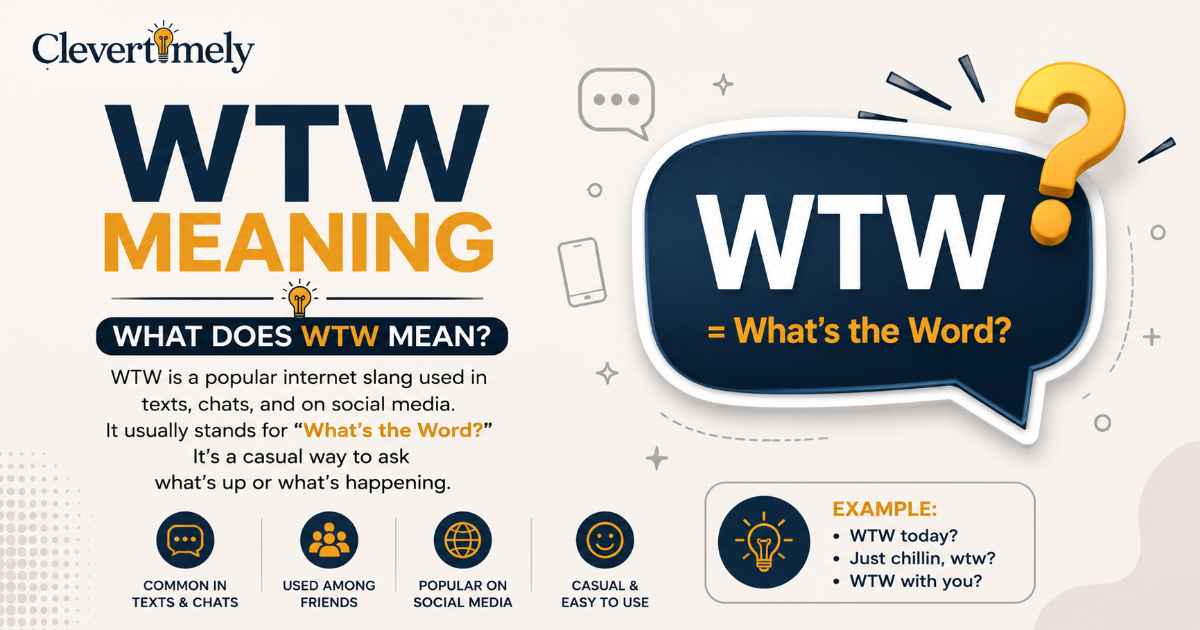
WTW stands for “What’s the Word?” in most texting and social media contexts. It is a casual, friendly way of asking what is happening, what the plan is, or how someone is doing. Think of it as the short-form version of “What’s up?” or “What’s going on?”
The phrase functions as an open-ended conversation starter. When someone sends you WTW, they are usually checking in, looking to make plans, or just trying to start a chat in a relaxed, low-pressure way.
A second popular meaning is “What’s the Wave?” which is especially common among younger users and carries the same energy: asking what is happening or what the move is.
Quick Examples
- “WTW tonight?” = What are you doing tonight? / Any plans?
- “WTW?” (on its own) = What’s up? / How are you?
- “WTW with you lately?” = What has been going on with you?
Primary Meaning
The primary and most widely recognized meaning of WTW in texting and social media is “What’s the Word?”
This phrase has deep roots in spoken English. People have used “What’s the word?” in everyday conversation for decades to ask for news, updates, or the latest gossip. As smartphones and messaging apps took over daily communication, users naturally shortened the phrase into a three-letter abbreviation that was faster to type and easier to send.
Today, WTW is used as a casual greeting, a conversation opener, and a plan-checker all rolled into one. Its real power is how flexible it is: the same three letters can mean a dozen slightly different things depending on who sends it and in what situation.
Read More: YNS Meaning Explained: Full Guide, Uses, and Online Context (2026 Insights)
Secondary Meanings
While “What’s the Word?” is the dominant meaning, WTW can also stand for several other phrases depending on the context:
| Abbreviation | Meaning | Context |
| WTW | What’s the Word? | Casual texting, social media |
| WTW | What’s the Wave? | Gen Z slang, youth culture |
| WTW | What’s the Way? | Planning context, gaming |
| WTW | Way to Win | Gaming, motivational posts |
| WTW | Walk the Walk | Encouragement, casual advice |
| WTW | Willis Towers Watson | Business and insurance industry |
| WTW | Wing Tip to Wing Tip | Aviation and engineering |
| WTW | World Trade Week | Business and commerce events |
The slang meanings dominate online conversations, but the context always matters. If you see WTW in a professional document or aviation manual, it almost certainly refers to something entirely different.
Background & Origin of WTW
The origin of WTW traces back to spoken urban slang, long before texting became mainstream. The phrase “What’s the word?” was commonly used in American street culture and hip-hop communities as a laid-back way of asking for news or updates. It carried the same energy as “What’s good?” or “What’s happening?”
When mobile phones and SMS messaging became widespread in the early 2000s, character limits and the inconvenience of typing on small keypads pushed people to shorten everything. Phrases like “What’s the word?” became WTW naturally. Early platforms like AOL Instant Messenger (AIM) played a huge role in normalizing abbreviations like this one in everyday digital conversation.
By the early 2010s, WTW had moved firmly into social media culture. By the early 2020s, it was a recognized staple of internet slang, especially in the United States and the UK. In 2026, it remains one of the most commonly searched and used texting abbreviations across platforms.
Rise Through Social Media
Social media accelerated the spread of WTW in ways that organic word-of-mouth never could. Platforms built for fast, short communication naturally rewarded abbreviations that conveyed full social meaning with minimal effort.
Snapchat, with its emphasis on quick snaps and brief messages, was one of the first platforms where WTW became a daily staple. TikTok then introduced the abbreviation to an even wider global audience through comments, captions, and video trends. Instagram DMs and story replies also helped normalize WTW for users who might not have grown up using it.
Unlike many internet slang terms that spike briefly and then fade, WTW has maintained consistent usage because it solves a real communication problem: how do you start a casual conversation without overthinking the opening line?
Why People Like Using It
- It feels relaxed and low-effort without coming across as cold
- It works as both a greeting and a plan-making opener
- It fits naturally into fast-paced digital communication styles
- It signals social awareness and cultural fluency, especially among younger users
- It invites a response without demanding one, keeping things pressure-free
Usage of WTW in Different Contexts
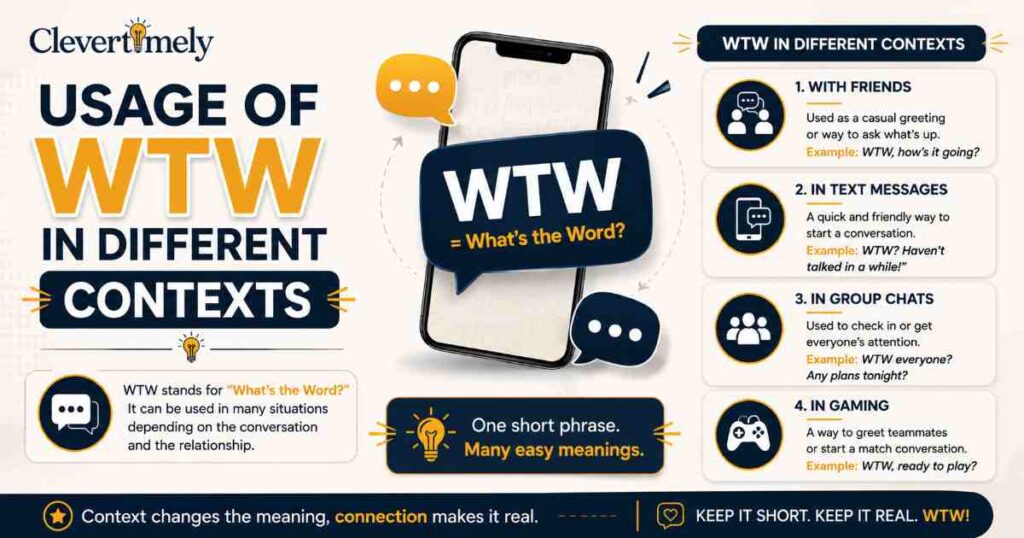
WTW is versatile enough to appear in all kinds of conversations. Here is how it plays out across the most common texting situations.
1. Casual Chat
This is the most common use case. Someone texts WTW simply to start a conversation or check in on a friend they have not heard from in a while. It is the digital equivalent of bumping into someone in the hallway and asking what is new.
Examples
- Jamie: WTW?
- Sam: Not much, just got off work. You?
- Alex: Haven’t seen you in forever. WTW?
- Jordan: Honestly been so busy lol. Tell me about it, WTW with you?
2. Social Media Conversations
On social media platforms, WTW shows up in comments, DMs, and even captions. It is used to engage with posts, check in with followers, or respond to someone’s story or video.
Examples
- Comment on a TikTok: “Bro WTW?? This is wild”
- DM on Instagram: “WTW this weekend? There’s a party Saturday”
- Reply to a Snapchat story: “WTW? You look like you’re having fun”
3. Dating & Flirting
WTW is a popular opener on dating apps and in early-stage flirty texting. It is casual enough to feel effortless but open-ended enough to invite a real conversation. When someone you are interested in sends “WTW tonight?” they are almost certainly hinting at plans and testing the waters.
Example
- Person A: WTW tonight?
- Person B: Nothing yet, why? You planning something?
- Person A: Maybe. You should come hang
4. Group Chats
In group chats, WTW is often used to gauge everyone’s availability or interest in making plans. It serves as a quick poll without actually running one.
Example
- Tyler: WTW Friday?
- Mia: I’m free after 7
- Marcus: Same, someone pick a spot
5. Gaming Communities
In gaming circles, WTW takes on a slightly different tone. Players use it to ask about strategies, upcoming matches, or what the game plan is for the session. “WTW?” in a Discord server or game lobby usually means “What’s the plan?” or “What are we doing?”
- “WTW on tonight’s ranked session?”
- “WTW with the new update? Anyone tried it?”
WTW Meaning Across Platforms
The core meaning of WTW stays consistent, but the tone and frequency of use can shift depending on the platform.
On WhatsApp, WTW usually appears in private one-on-one chats or group threads between friends and family. It is used to check in, make plans, or restart a conversation that went quiet.
Example
- Mum: WTW? Haven’t heard from you all week
- You: Sorry, been slammed with work. Everything good though!
On Instagram, WTW appears in DMs and comment sections. It is often used in response to someone’s story or as an opening message to someone you follow but have not talked to in a while.
Example
- DM: Saw your story, WTW with that trip you mentioned?
- Reply: Omg yes!! I’m going next month, so excited
TikTok
TikTok has given WTW a life beyond simple conversation. It appears in video comments to express surprise, curiosity, or interest in a situation. The hashtag #WTW has also been used in challenge-related content.
Example
- Comment: “WTW he actually did that??”
- Caption: “WTW tonight lol stay tuned”
Snapchat
Snapchat is one of the natural homes of WTW because the platform is built for quick, casual communication. Streak maintenance often leads to short WTW messages that double as friendly check-ins.
Common Snapchat Uses
- Keeping streaks alive: “WTW?” sent as a daily snap
- Making plans: “WTW later?” with a photo of an empty calendar
- Reacting to someone’s story: “WTW is this?? 😂”
- Flirting: “WTW tonight?” hinting at spending time together
Other Meanings of WTW in Different Fields
WTW does not belong exclusively to internet slang. In professional and technical fields, the abbreviation carries completely different meanings.
Business
In the business world, WTW most commonly refers to Willis Towers Watson, a global advisory, broking, and solutions company specializing in risk management and insurance. If you see WTW in a financial report, news article, or professional document, this is almost certainly what it means. The company is publicly traded and widely recognized in the insurance and HR consulting industries.
WTW can also occasionally stand for World Trade Week, a recognized annual event focused on international trade and commerce.
Physics & Engineering
In physics and engineering, WTW can refer to Work to Weight ratio, a measurement used to assess the efficiency of engines, machines, or structural systems. It compares the output work of a system against its physical weight to determine performance efficiency.
Aviation
Aircraft engineers and aviation professionals sometimes use WTW to mean Wing Tip to Wing Tip, which refers to the total wingspan measurement of an aircraft. This is a standard measurement used in aircraft design, hangar planning, and airport logistics.
Medical Context
In medical settings, WTW occasionally appears in internal clinical shorthand, though it is not standardized across hospitals or healthcare institutions. Its medical meaning varies by institution and context, so it is not safe to assume any universal definition in a clinical setting.
Common Misconceptions & Mistakes
Thinking It Always Means “What’s Up”
While WTW is often used similarly to “what’s up,” the two are not identical. WTW specifically invites a more open-ended response. It asks for the word, the plan, the news, or the general update, whereas “what’s up” is often treated as a throwaway greeting that does not necessarily expect a real answer.
2: Assuming It’s Professional
WTW is informal slang. Using it in work emails, formal messages, or client communication is a mistake. Even in industries where casual communication is the norm internally, WTW can come across as too informal or even confusing to people unfamiliar with internet slang.
Confusing It With WTW Company References
If you work in insurance or risk consulting, seeing WTW in a professional context almost certainly refers to Willis Towers Watson, not internet slang. Mixing up these two meanings in a workplace setting can cause real confusion.
Overusing It
Like any slang term, using WTW too frequently in a single conversation makes it lose its casual charm. Sending “WTW?” three times in a row with no real variation comes across as low-effort. The best use of WTW is as a conversation opener, not a filler.
Similar Terms & Alternatives
If WTW does not feel right for a given situation, these alternatives carry a similar meaning and tone:
| Term | Meaning | Best Use |
| WYD | What You Doing? | Asking about current activity |
| WYA | Where You At? | Asking about location |
| SUP | What’s Up? | Quick, casual greeting |
| HMU | Hit Me Up | Inviting someone to reach out |
| WUU2 | What You Up To? | British texting slang |
| NGL | Not Gonna Lie | Expressing honesty |
| ITE | Alright? | British casual greeting |
How to Respond to WTW
The best response to WTW depends on the tone of the conversation and what the sender is really asking. Here are some natural, ready-to-use replies across different situations.
Casual Replies
- “Not much, just chilling. You?”
- “Been busy honestly. How about you?”
- “Nothing wild, same old stuff. WTW with you?”
Flirty Replies
- “Depends who’s asking 😏”
- “Could be a fun night. Why, you got plans?”
- “Nothing set yet. Make me an offer 😄”
Plan-Making Replies
- “Free after 6. What are you thinking?”
- “Nothing yet, let’s do something”
- “I’m around. What’s the move?”
Chat-Style Examples
- Message: WTW tonight?
- Reply: Nothing solid yet. Was thinking about grabbing food somewhere. You?
- Message: WTW? Haven’t talked in forever
- Reply: I know!! Been so busy. Fill me in on your life first
Differences Between WTW and Similar Slang
WTW vs WYD
These two are often confused because they serve a similar purpose, but they have slightly different meanings and imply different things.
WTW
WTW is broader and more open-ended. It asks for news, plans, updates, or general vibes. It does not pin the conversation to a specific moment in time. It feels slightly more casual and inviting.
WYD
WYD (What You Doing?) is more specific. It is asking about what someone is doing right now, in this moment. It is a bit more direct and slightly less open to interpretation. WYD tends to imply you want to do something together or at least know what is taking up someone’s time.
WTW vs WYA
WYA
WYA stands for “Where You At?” This abbreviation is location-focused. It is asking for your physical whereabouts, not a general update on your life or plans. If someone is trying to find you or meet up, they send WYA. If they just want to catch up or start a chat, they send WTW.
WTW vs “What’s Up”
“What’s up” is the classic, universal, evergreen greeting that almost everyone understands regardless of age or background. WTW is the younger, slang-forward version that carries the same general energy but feels more specific to internet and texting culture. “What’s up” is also generally more acceptable in slightly more formal casual settings, while WTW stays firmly in the informal zone.
WTW in Online Conversations & Dating Apps
Dating apps and romantic texting have given WTW a unique role as a low-commitment, high-versatility opener. On platforms like Hinge, Bumble, or Tinder, sending “WTW?” to someone you matched with signals that you are interested, relaxed, and not trying too hard. It leaves the door open for the other person to set the tone of the conversation.
Why People Use It While Flirting
WTW works well in flirting because it is:
- Open-ended, giving the other person room to respond however they want
- Casual enough to feel effortless but engaged enough to show interest
- Ambiguous in a useful way: it can be purely friendly or subtly suggestive depending on timing and tone
- Low-stakes as an opener, reducing the pressure that comes with more direct flirting
Example
- Match: WTW tonight?
- You: Not sure yet, convince me to go out 😄
- Match: Okay I know this rooftop bar that has the best views in the city
Social Psychology Behind It
WTW taps into something deeper than just communication efficiency. Psychologically, it satisfies the social need for connection without the vulnerability of a more direct or emotional reach-out. By asking “what’s the word?” someone signals interest in the other person’s life without committing to any specific conversational direction.
This makes WTW a socially safe choice. If the response is warm, the conversation flows. If it is short or unenthusiastic, neither person has invested much. That low-pressure quality is a big part of why WTW resonates so strongly in digital culture, where people often prefer casual connection over formal social obligations.
Popularity & Trends Over Time
Why It Became Popular
WTW grew from a phrase used primarily in urban American communities into a mainstream digital abbreviation through a fairly predictable but powerful process. As hip-hop culture and street slang increasingly influenced mainstream media and social media, terms like WTW crossed cultural boundaries and became widely adopted.
The rise of smartphones in the late 2000s created the conditions for abbreviations to thrive. Texting on small keyboards made short forms attractive. When messaging apps became the dominant form of communication for teenagers and young adults, abbreviations like WTW moved from niche slang to everyday vocabulary.
Social Media Impact
Platforms like TikTok, Instagram, and Snapchat accelerated this process massively. When users see a term repeated in hundreds of videos or comments, they absorb it and start using it themselves. WTW benefited from this cycle repeatedly as new generations of younger users picked it up and brought it into their own social circles.
In 2026, WTW continues to appear consistently in search trends and is still widely used across all major social media platforms. Unlike slang that fades within months, WTW has proven durable because of how adaptable and genuinely useful it is as a social signal.
FAQs
What does WTW mean in texting?
WTW most commonly means “What’s the Word?” in texting. It is a casual way to ask what is happening, what someone is up to, or what plans are in place.
What does WTW mean on Snapchat?
On Snapchat, WTW usually means “What’s the Word?” and is used to start conversations, check in on friends, keep streaks going, or ask about plans.
Is WTW flirting?
WTW is not inherently flirty, but it can carry a flirty tone depending on context, timing, and the relationship between the people involved. “WTW tonight?” from someone you are interested in often carries romantic undertones.
What does WTW mean from a girl?
When a girl sends WTW, it carries the same meaning as from anyone else: she is asking what is happening or what the plan is. Tone and context determine whether it is purely friendly or something more.
Is WTW rude?
No, WTW is not rude. It is an informal, friendly abbreviation. The only issue is using it in professional or formal settings where slang is inappropriate.
What should I reply to WTW?
Reply based on the tone of the conversation. Casual replies like “Not much, you?” work well for friendly check-ins. If the person is clearly asking about plans, respond with your availability or suggest something specific.
Related Search Queries
- WTW meaning in text
- What does WTW mean on Snapchat
- WTW meaning from a girl
- WTW slang definition
- WTW vs WYD
- WTW meaning TikTok
- How to reply to WTW
- WTW meaning in dating
- WTW meaning Instagram
- What does WTW stand for
Conclusion
WTW is one of those abbreviations that feels simple on the surface but carries real social weight in digital communication. Whether it shows up in a text from a friend, a DM on Instagram, a snap from someone you like, or a comment on TikTok, the message is almost always the same: let’s connect, catch up, or make something happen.
The most common WTW meaning is “What’s the Word?” which works as a casual greeting, a plan-opener, and a friendly check-in all at once. That flexibility is exactly why it has stayed relevant across multiple years and multiple platforms while countless other slang terms came and went.
Now that you know what WTW means, where it came from, and how to use it, you are ready to reply with confidence the next time it lands in your inbox. And honestly? WTW later sounds like a pretty good plan.

